Asif Iqbal Naik
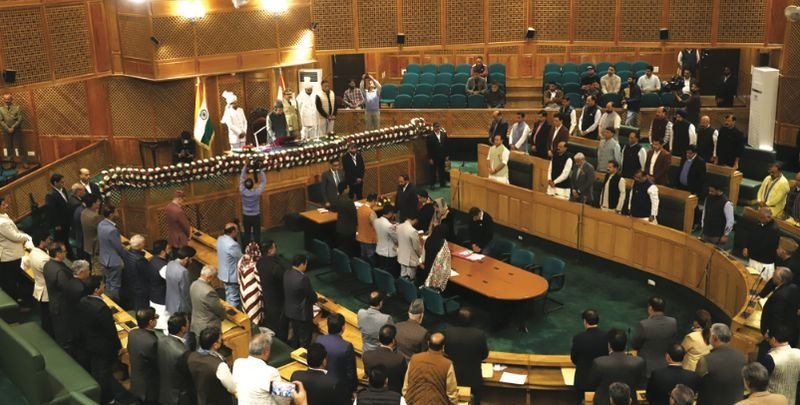
Jammu, Feb 11: The Jammu and Kashmir Legislative Assembly is scheduled to take up significant legislative and financial business during today’s sitting, including the introduction of a key amendment bill and discussion and voting on major Demands for Grants for the financial year 2026–27.


The House that resume work at 10:00 AM had begin proceedings with Question Hour, during which members are expected to seek replies from the government on various public issues across departments.
Chief Minister Omar Abdullah is slated to introduce “The Jammu and Kashmir Civil Courts (Amendment) Bill, 2026” (L.A. Bill No. 03 of 2026). The proposed legislation seeks to amend the Jammu and Kashmir State Civil Courts Act (Svt. 1977) by replacing the designations “Munsiff” and “Subordinate Judge” with “Civil Judge (Junior Division)” and “Civil Judge (Senior Division)” respectively, bringing the nomenclature in line with other States and Union Territories. The Bill also proposes to enhance the pecuniary jurisdiction of Civil Judges (Junior Division) from ₹15,000 to ₹10 lakh.
The Assembly will also take up discussion and voting on Demands for Grants relating to key departments. Under Demand No. 7, the government has sought approval of ₹7,12,98,872.13 lakh for School Education, Sports and Youth Services, and Capital Outlay on Education and allied sectors. Demand No. 17 relating to Health and Medical Education proposes an allocation of ₹78,65,476.57 lakh for Medical and Public Health, Family Welfare and capital expenditure in the sector. Under Demand No. 18 concerning Social Welfare, including Welfare of Scheduled Castes, Scheduled Tribes, Other Backward Classes, Social Security and Nutrition, a sum of ₹24,45,671.59 lakh has been proposed. Demand No. 27 for Higher Education seeks approval of ₹72,15,016.37 lakh for General and Technical Education and related capital outlays.
Several members have submitted cut motions on these demands, seeking detailed discussion on issues such as vacancies in education and health departments, infrastructure gaps in schools and hospitals, enhancement of pensions, honorarium for Anganwadi workers, implementation of reservation policies and strengthening of higher education institutions.
The sitting is expected to witness detailed deliberations as legislators scrutinize departmental allocations and raise constituency-specific concerns before the House proceeds towards voting on the grants.