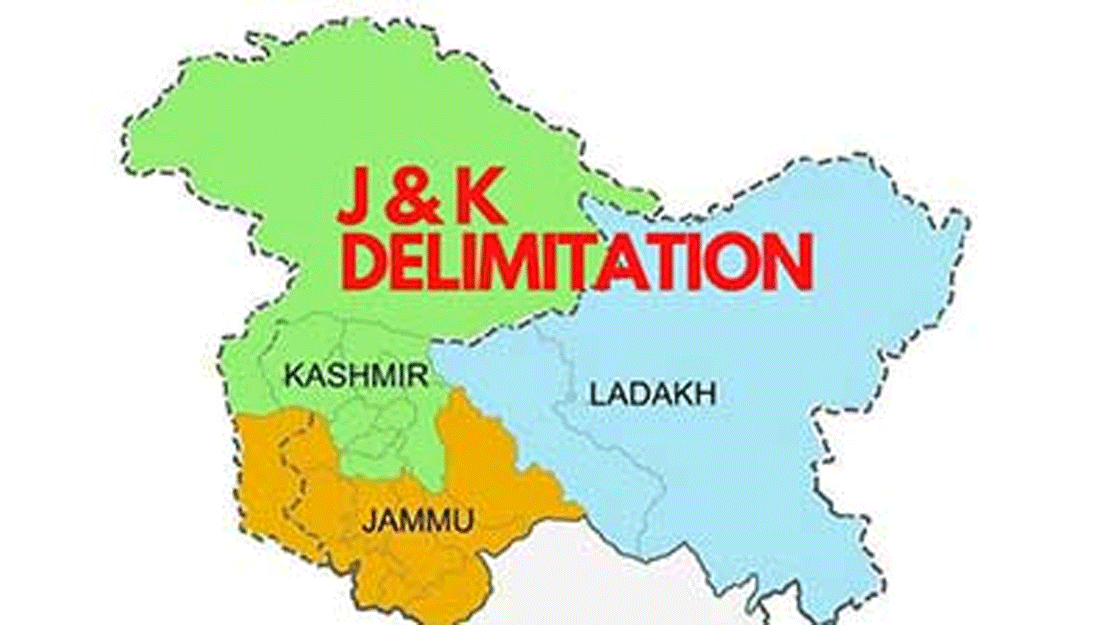
Delimitation is often presented as a technical exercise—neutral, arithmetical, and insulated from politics. In reality, it is one of the most consequential instruments in a democracy because it translates population into power. In Jammu and Kashmir, where political authority has historically been concentrated in one region, the relationship between census data, population growth, and legislative representation deserves closer scrutiny—especially as India prepares for its next census in 2026, followed by a fresh round of delimitation.
India’s demographic transition since Independence is well documented. Between 1951 and 1981, the country experienced rapid population growth driven by high fertility and declining mortality, with decadal growth rates ranging between 23 and 25 percent. After 1981, a clear shift occurred. Fertility declined across most regions, education levels improved, and population growth began to slow. By the 2001–2011 decade, India’s decadal growth rate had fallen to about 17.6 percent, marking a decisive move into demographic deceleration.


Until the 1971 Census, Jammu and Kashmir broadly followed this national trajectory. Its population increased from roughly four million in 1941 to about 4.6 million in 1971—consistent with a largely rural, mountainous region. There was no evident demographic anomaly, nor any reason to anticipate political imbalance rooted in population numbers.
The divergence becomes visible after 1981. Between 1981 and 2011, Jammu and Kashmir’s population more than doubled—from about 5.99 million to roughly 12.54 million. The 2001–2011 decadal growth rate, at around 23.6 percent, was significantly higher than the national average of 17.6 percent. At a time when most of India was witnessing slowing growth, Jammu and Kashmir—particularly the Kashmir Valley—was not.
Aggregated data, however, conceals the core issue. Jammu and Kashmir has never been demographically uniform. District-level figures show that accelerated population growth has been overwhelmingly concentrated in the Kashmir Valley. Districts in the Jammu region largely mirror national averages, while Ladakh’s growth remains modest due to geography and climate. The divergence, therefore, is not state-wide; it is valley-centric. This matters because legislative representation—and by extension, political power—has historically been determined by population rather than territory.
The political consequences of this arithmetic are neither theoretical nor new. Since the inception of electoral politics in Jammu and Kashmir, governments have overwhelmingly emerged from Kashmir-based political formations. Faster population growth in the Valley ensured that this structural pattern remained intact, regardless of electoral shifts in Jammu. A more balanced demographic trajectory might, over time, have altered that equation.
The timing of this divergence also intersects with political developments. In 1975, following the Indira–Sheikh Accord, Sheikh Abdullah returned to power after more than two decades of political marginalisation. For many observers, this marked the consolidation of a Kashmir-centric political order that shaped institutions and priorities for decades. It was during this period that questions about census figures and demographic trends began surfacing more openly.
Critics have long argued—without definitive proof, but citing persistent circumstantial reasoning—that post-1975 demographic outcomes were politically convenient in preserving the centre of power within the Kashmir Valley. The argument is structural: had population growth remained broadly uniform across the territory, Jammu’s larger geographical size might, over successive delimitations, have translated into greater legislative representation. That, in turn, could have challenged the entrenched assumption that political power must reside in Kashmir.
Major political parties in India have repeatedly questioned the reliability of the 2011 Census. If such concerns are considered valid, a deeper examination of earlier data—particularly post-1981—becomes equally important. Establishing deliberate inflation would require granular evidence far beyond aggregate census tables. Yet it would also be unreasonable to ignore the consistent alignment between demographic outcomes and political incentives over several decades. That alignment alone explains why census data in Jammu and Kashmir continues to attract sustained scrutiny. (Agencies)