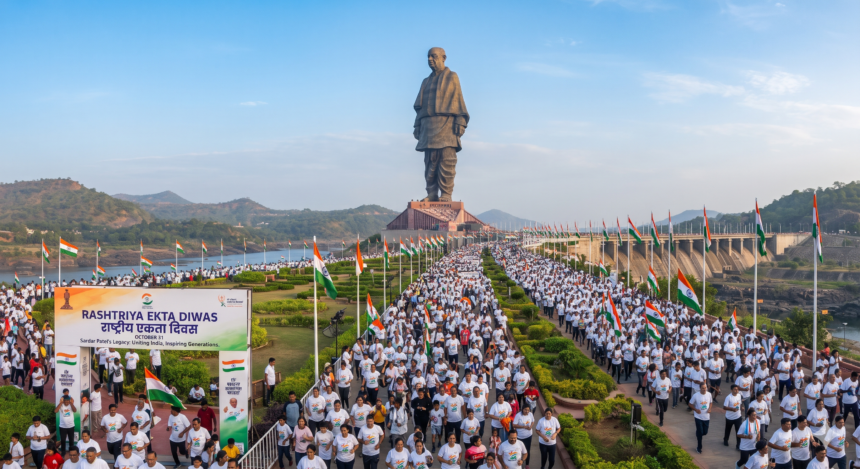
Observed on October 31, Rashtriya Ekta Diwas honours Sardar Vallabhbhai Patel’s role in India’s integration while highlighting the need for inclusive development, social harmony and democratic cooperation.
India will observe Rashtriya Ekta Diwas on October 31, marking the birth anniversary of Sardar Vallabhbhai Patel, one of the country’s most influential leaders and a key architect of national integration. The occasion serves as a reminder that national unity extends beyond territorial integrity and depends on social trust, inclusive development and a shared sense of belonging among citizens.


Introduced by the Government of India in 2014, Rashtriya Ekta Diwas commemorates Patel’s contribution to the freedom struggle and the integration of princely states following Independence. Activities such as the Run for Unity, unity pledges and public programmes are organised to promote national cohesion and reaffirm the country’s commitment to unity, integrity and security.
Patel’s Role in Building a United India
Following Independence in 1947, India faced the complex task of integrating hundreds of princely states into the newly established Union. As the country’s first Deputy Prime Minister and Home Minister, Patel played a pivotal role in the process, working closely with V. P. Menon and other officials to secure the accession of princely states through negotiations and political persuasion.
The integration process laid the political foundations of modern India and helped prevent the fragmentation of the newly independent nation. Patel’s leadership remains a significant part of the country’s political history, demonstrating the importance of decisive leadership, negotiation and a common national vision.
National Unity Through Inclusive Development
India’s contemporary challenges differ significantly from those faced at the time of Independence. Today, sustaining national unity requires ensuring that economic growth, infrastructure development and technological progress translate into meaningful opportunities for people across regions.
Improved transport networks, digital connectivity and infrastructure projects, particularly in border areas and the Northeast, can strengthen regional links and expand access to markets and public services. However, lasting national cohesion also depends on addressing disparities in employment, education, healthcare and investment.
Cooperative federalism remains central to this effort. Coordination between the Union and state governments on infrastructure, industry, education, public health and security can help balance national priorities with regional aspirations. Respect for constitutional responsibilities and democratic institutions is essential to managing differences constructively.
Diversity, Social Harmony and Youth Participation
India’s diversity of languages, cultures, traditions and regional identities is an important part of its national character. Unity does not require these differences to disappear; rather, it requires citizens to recognise their shared constitutional framework while respecting one another’s identities.
In an increasingly connected digital environment, public discourse can promote understanding but may also deepen mistrust and polarisation. Responsible communication, equal respect for citizens and confidence in democratic institutions remain important to maintaining social harmony.
Young people can contribute to national integration through educational exchanges, cultural programmes, inter-state travel and greater engagement with communities beyond their home regions. The Ek Bharat Shreshtha Bharat initiative, announced in 2015, seeks to strengthen mutual understanding and cultural exchange between states and Union Territories.
Such efforts can help transform national unity from an abstract principle into an everyday experience of citizenship.
Unity as a Continuing National Responsibility
Rashtriya Ekta Diwas also draws attention to the relationship between national security, social inclusion and development. While protecting territorial integrity and maintaining public order remain essential responsibilities, lasting stability also depends on access to opportunities, effective public services and meaningful participation in democratic life.
Patel’s legacy, therefore, carries significance beyond the historical integration of princely states. While his leadership helped establish the foundations of a united India, the responsibility of sustaining that unity rests with successive generations.
As India pursues its economic ambitions and seeks a greater role on the global stage, national cohesion will remain closely linked to inclusive growth, democratic cooperation and mutual respect.
Rashtriya Ekta Diwas serves as a reminder that unity is not merely an achievement inherited from the past. It is an ongoing national responsibility that must be strengthened through the everyday experiences, rights and shared aspirations of citizens.