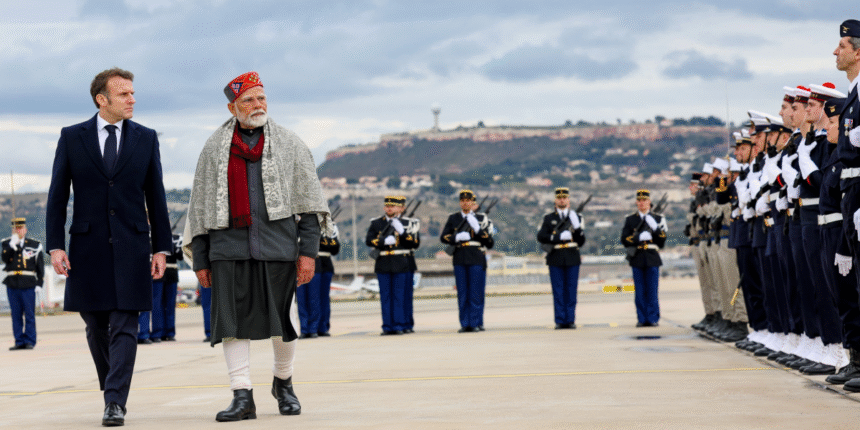
When Prime Minister Narendra Modi met French President Emmanuel Macron in Mumbai on Tuesday, he highlighted freedom fighter Vinayak Damodar Savarkar as a key historical link between India and France, recalling what he described as a “saga of bravery” dating back more than a century.
Referring to Savarkar as “Veer” (brave), Modi mentioned the dramatic 1910 escape attempt in the French port city of Marseille. He recalled that during his visit to France last year for the AI Action Summit at Macron’s invitation, he had also travelled to Marseille — France’s largest port and a historic gateway to Europe.
Modi noted that Marseille is the city where Indian soldiers first set foot in Europe during World War I, and their bravery is still remembered across parts of the continent. He added that it was also the same city where Savarkar leapt into the sea in an attempt to escape British custody, calling the act a symbol of his unwavering commitment to India’s independence.
Savarkar had been arrested in London in 1910 in connection with the Nasik Conspiracy Case, accused of sending the revolver used in the assassination of British official A.M.T. Jackson in 1909. While being transported to India by ship for trial, he jumped into the sea near Marseille and swam to the French shore despite gunfire from the vessel.
However, he was detained on French soil and later handed back to British authorities. The French government protested the arrest, taking the matter to the Hague tribunal and arguing that the extradition was irregular. The dispute was eventually submitted to arbitration. The tribunal ruled that although there had been procedural irregularities, Britain was not obligated to return Savarkar to France.
Back in India, Savarkar was tried for sedition in Bombay in 1910 and sentenced to two life terms, amounting to nearly 50 years of imprisonment. He was sent to the notorious Cellular Jail in the Andaman and Nicobar Islands, where he spent over a decade performing hard labour.
After his transfer to Ratnagiri in 1924 and eventual release in 1937, Savarkar became associated with the Hindu Mahasabha, serving as its president for several years.
Savarkar remains a polarising figure in Indian politics. Supporters, including leaders of the Rashtriya Swayamsevak Sangh and the Bharatiya Janata Party, hail him as a nationalist hero and ideologue of Hindutva. Critics, including members of the Indian National Congress, have questioned his mercy petitions to the British during his imprisonment.
Savarkar passed away in 1966 at the age of 83. Over the years, there have been recurring demands from sections of the Sangh Parivar that he be awarded India’s highest civilian honour, the Bharat Ratna. (Agency)