By Raja Sarfaraz
SRINAGAR: Jammu and Kashmir continues to face a serious unemployment challenge, with thousands of educated young people struggling to secure stable jobs despite years of academic preparation. While official statistics indicate some improvement in overall employment indicators, high youth unemployment, vacant government positions and recruitment-related controversies remain major concerns.


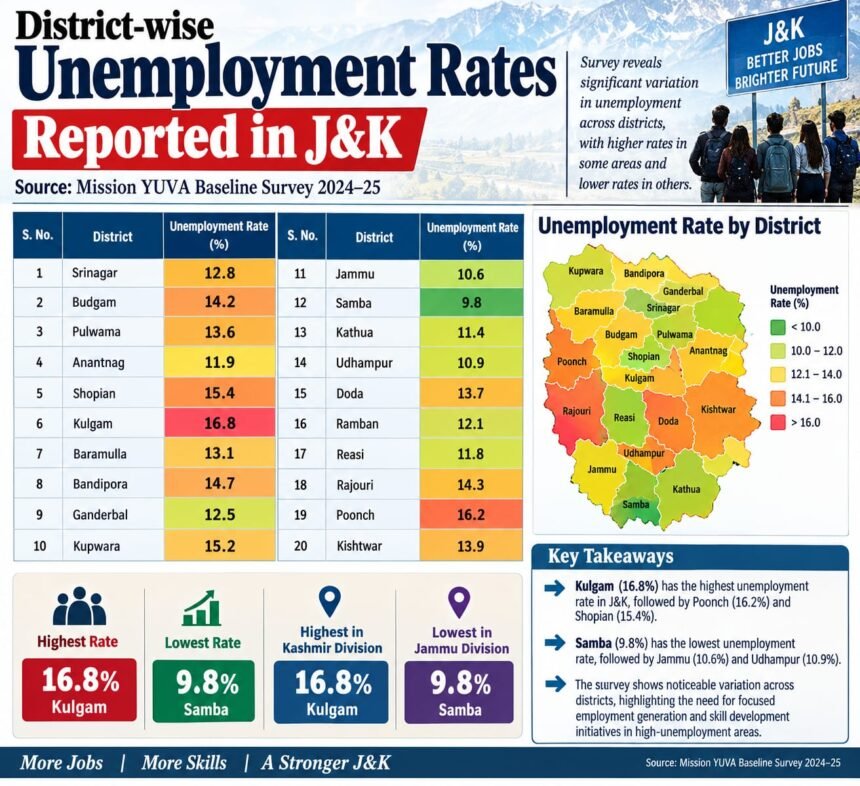
According to the Jammu and Kashmir Economic Survey 2025–26, the overall unemployment rate declined from 6.7% in 2019–20 to 6.1% in 2023–24. However, the Mission YUVA Baseline Survey 2024–25 estimated youth unemployment at 17.4%, significantly above the national figure of 10.2%.
The two figures are based on different statistical measures, but they highlight the continuing difficulties faced by young jobseekers across the Union Territory.
59,175 Government Posts Remain Vacant
A major concern emerged when the Jammu and Kashmir Legislative Assembly was informed on April 1, 2026, that 59,175 government posts were vacant across 38 departments.
Of these, 48,958 were non-gazetted positions and 10,217 were gazetted posts. The vacancies included 28,315 direct-recruitment posts and 30,860 promotion-quota positions.
Although not all vacancies are available for fresh recruitment, the figures have intensified questions about recruitment planning, administrative delays and employment opportunities for qualified candidates.
Educated Youth Struggle to Find Opportunities
Government figures reported in January 2025 showed that 3,70,811 unemployed young people were registered on the J&K employment portal, including 66,628 graduates, 47,114 postgraduates and 9,884 diploma holders.
The Mission YUVA survey also identified approximately 4.73 lakh people aged 18–60 as unemployed and willing to work.
These figures reflect different methods of measuring unemployment and should not be treated as interchangeable.
For many educated candidates, the struggle extends beyond securing a government job. Limited private-sector opportunities, inadequate industry exposure and mismatches between academic qualifications and market requirements have made finding suitable employment increasingly difficult.
Recruitment Cancellations Add to Frustration
Recruitment controversies have further complicated the employment situation.
In 2022, the administration cancelled selection processes involving 1,200 Police Sub-Inspector posts, 972 Finance Accounts Assistant posts and 163 Junior Engineer (Civil) posts.
Together, these cancellations affected recruitment processes covering 2,335 advertised positions.
In another development, 103 Fire and Emergency Services firemen were terminated in December 2025 following findings of fraudulent manipulation in their appointments.
Such developments have raised concerns about recruitment transparency, accountability and the time candidates lose while preparing for competitive examinations.
Private-Sector Employment Remains Crucial
Experts and employment observers have repeatedly highlighted the need to reduce excessive dependence on government recruitment by strengthening private-sector opportunities.
Tourism, horticulture, agriculture, handicrafts, food processing, information technology and entrepreneurship could provide additional employment opportunities if supported through investment, infrastructure, training and access to markets.
However, the success of employment initiatives must be measured not merely by the number of businesses established but by the sustainable jobs, incomes and long-term economic opportunities they generate.
Growing Demand for a Comprehensive Employment Strategy
The continuing unemployment challenge has brought renewed attention to the need for transparent recruitment calendars, faster filling of eligible vacancies, industry-linked education and district-specific employment initiatives.
Regular publication of department-wise vacancies, examination results, recruitment progress and employment statistics could improve accountability and help restore confidence among jobseekers.
For Jammu and Kashmir’s educated youth, the fundamental concern remains unchanged: whether years of education and preparation will translate into secure employment and meaningful professional opportunities.
The larger challenge for policymakers is to move beyond employment announcements and ensure that recruitment, investment and economic development produce measurable, sustainable jobs for the region’s younger generation.
Sources: J&K Economic Survey 2025–26, Mission YUVA Baseline Survey 2024–25, Legislative Assembly disclosures and reported government recruitment data.