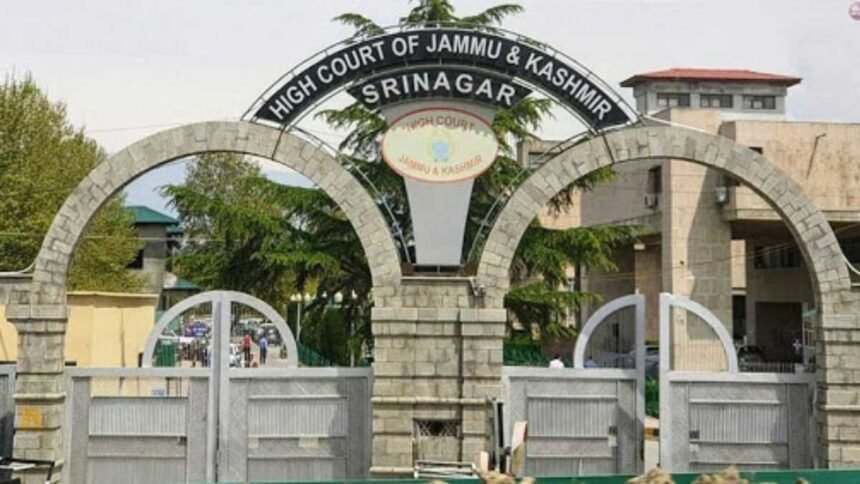
Jammu, April 02, 2026: In a landmark and historic judgment, the High Court of Jammu & Kashmir and Ladakh at Jammu has brought closure to a decades-long legal dispute over the ownership and management of two revered shrines in Kishtwar — Ziarat Shah Farid-ud-Din Sahib and Ziarat Shah Assrar-ud-Din Sahib.
The judgment was delivered by Justice Sanjay Dhar, finally settling litigation that began in 1979 and travelled across multiple judicial forums, including the Supreme Court of India.


⸻
Case Title & Parties Involved
The case, titled “Syed Lutfullah Shah & Anr vs A.W. Kirpak, Superintendent Engineer & Others”, involved:
• Petitioners:
Syed Lutfullah Shah and others, claiming hereditary custodianship (Sajjada Nasheen rights)
• Respondents:
A.W. Kirpak (then Administrator/Wakaf authority), along with officials of the Wakaf Board and government authorities
⸻
Historical Background: Kishtwar & the Sacred Ziarats
Kishtwar – Once an Independent Hill State
The judgment revisits the deep historical roots of Kishtwar, noting that:
• Kishtwar was an independent princely state before its annexation by Maharaja Gulab Singh in 1821 AD
• It was ruled by local monarchs, including Raja Kirat Singh, a prominent ruler of the region
• Historical accounts suggest that Raja Kirat Singh embraced Islam in the late 17th century, reflecting the region’s evolving cultural and religious landscape 
This layered history adds context to the religious and socio-cultural importance of the shrines in dispute.
⸻
Origin & Significance of the Two Ziarats
The two shrines at the centre of the dispute are among the most revered spiritual sites in the Chenab Valley:
Ziarat Shah Farid-ud-Din Sahib
• A revered Sufi saint believed to have arrived in the region around 1664 AD
• Passed away in 1725 AD at an advanced age
• His shrine attracts thousands of devotees annually
Ziarat Shah Assrar-ud-Din Sahib
• Son of Shah Farid-ud-Din Sahib and also a respected spiritual figure
• Passed away earlier, around 1685 AD
• His Urs is observed with great reverence and is even declared a public holiday in Kishtwar, Doda, and Ramban districts
Over centuries, separate mausoleums (Ziarats) were constructed at their resting places, evolving into major centres of faith and devotion. 
⸻
Genesis of the Legal Dispute
The dispute arose over:
• Whether the shrines are:
• Private hereditary properties of the Sajjada Nasheens
OR
• Public Wakf properties governed under Wakf laws
The litigation began in 1979, went through multiple stages, and was even remanded by the Supreme Court in 2013 for fresh adjudication.
⸻
Key Legal Findings by the Court
After examining historical records, legal provisions, and revenue documents, the Court held:
1. Wakf by User Established
• The shrines qualify as Wakf by long religious usage, even without formal dedication
2. No Proof of Private Ownership
• Petitioners failed to produce credible legal documents proving ownership
• Historical texts were held inadmissible for determining title
3. Revenue Records Favoured Ziarats
• Jamabandi records consistently showed ownership in the name of the shrines
• These entries were treated as strong legal evidence
4. 1969 Report Lacked Legal Finality
• The earlier Special Officer report:
• Was never gazetted
• Did not attain finality
• Could not override later findings
5. Due Process Upheld
• Petitioners were given adequate opportunities
• No violation of natural justice was found
⸻
Final Verdict
The High Court ruled that:
• The two Ziarats and their attached properties are Wakf properties
• Petitioners have no proprietary ownership rights
• Findings of the Special Officer (1979) and appellate authority (1982) stand upheld
The writ petitions were dismissed, marking the end of a 47-year-long legal battle.
⸻
Special Mention: Role of Late Abdul Latief Kamal (Patwari)
Amid the legal and historical discourse, the contribution of Late Abdul Latief Kamal, Patwari, has been widely acknowledged.
• He had painstakingly compiled and preserved critical revenue records, including Jamabandi entries
• These records consistently established the shrines’ ownership, forming a key evidentiary backbone of the case
• The Court’s reliance on revenue documents highlights the enduring value of his meticulous work
His role is being remembered as a quiet yet decisive contribution that helped establish the Wakf character of the shrines.
⸻
Significance of the Judgment
This verdict is considered historic because it:
• Ends a nearly five-decade-long dispute
• Reinforces the doctrine of Wakf by user
• Establishes that revenue records outweigh historical narratives in property disputes
• Sets a precedent for similar cases across Jammu & Kashmir
⸻
Impact on Shrine Administration
The ruling is expected to:
• Strengthen Wakaf governance over religious institutions
• Ensure transparent and structured management of the shrines
• Prevent future disputes over private claims on public religious assets