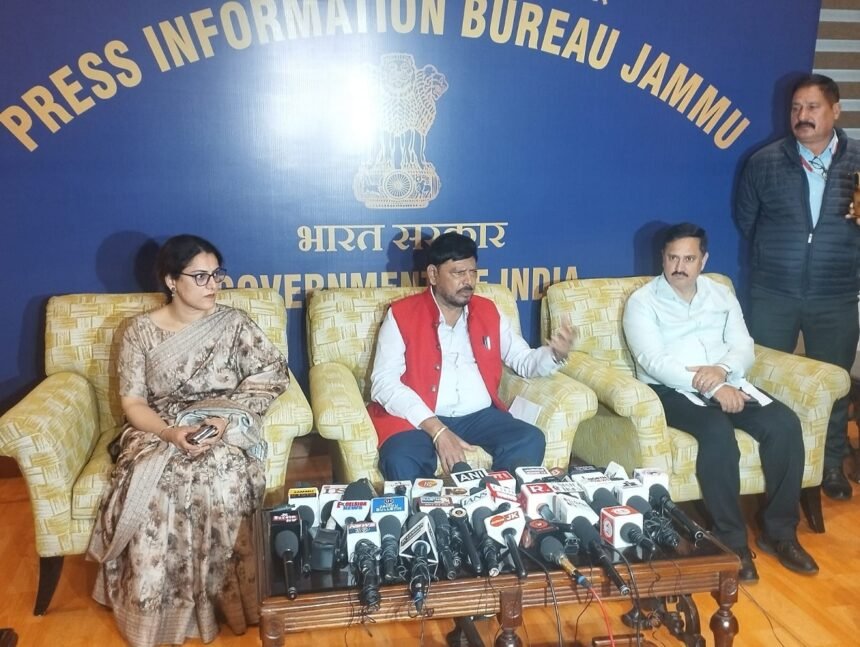
Jammu, Mar 16: Union Minister Ramdas Athawale on Sunday appealed to Naxalites to renounce violence and join the democratic mainstream, while condemning the recent attack on National Conference president Farooq Abdullah, calling it a serious and unacceptable incident in a democratic country.
Speaking to reporters here, the Republican Party of India (RPI) president said the Centre stands firmly with the people of Jammu and Kashmir, adding that the region has witnessed notable progress since the abrogation of Article 370 in 2019. He also expressed hope that statehood to the Union Territory could be restored soon.


Referring to the March 11 attack on Farooq Abdullah, Athawale described it as unfortunate and condemnable. “He has always supported strong ties between Jammu and Kashmir and the rest of India. There may be ideological differences, but democratic values must be respected. No one has the right to take someone’s life,” he said.
Athawale said Union Home Minister Amit Shah has spoken to Abdullah and directed authorities to further strengthen his security.
The Union Minister reiterated that the government opposes all forms of violence and wants peace to prevail across the country. Referring to efforts to curb Naxalism, he urged those involved in extremist activities to abandon violence and follow the democratic path.
“Killing people does not resolve issues. If you fight for justice through violence, it harms both you and society. If there are demands for justice for the poor, tribals or those living in hilly areas, they should be raised through democratic institutions like Parliament and state assemblies,” he said.
Athawale urged Naxalites to follow the path shown by Dr B.R. Ambedkar, who believed in equality and democratic values, adding that Prime Minister Narendra Modi’s vision of “Sabka Saath, Sabka Vikas” focuses on inclusive development.
“After the removal of Article 370, good progress is taking place in Jammu and Kashmir, and efforts are being made to generate employment opportunities for unemployed youth. Our stand is that peace must always prevail in the region,” he said.
He also recalled that when the Centre bifurcated the former state of Jammu and Kashmir into two Union Territories, it had assured that statehood would be restored at an appropriate time. “A decision on restoring statehood may be taken soon,” he added.
Highlighting development initiatives, Athawale said the Modi government has given special attention to Jammu and Kashmir and the northeastern states since 2014, focusing on infrastructure, connectivity and economic growth.
He pointed to the expansion of national highways, progress in railway projects and the extension of rail connectivity towards Kashmir, including major tunnel projects, as examples of the Centre’s commitment to development in the region.
Athawale also said the government is working to strengthen the economy, promote micro, small and medium enterprises (MSMEs) and improve connectivity nationwide, adding that India has now emerged as the world’s fourth-largest economy.
He criticised the Congress for opposing the India–US trade agreement, asserting that the deal would create employment, strengthen MSMEs and boost the country’s economy.
The Minister also said there is no immediate shortage of petrol, diesel or LPG despite the ongoing conflict in West Asia. While acknowledging that the war situation remains uncertain, he stressed that India hopes for an early end to hostilities and believes conflicts should not harm innocent civilians or public infrastructure.
Athawale said India maintains strong diplomatic ties with countries such as Iran, the United States and Israel, which helps ensure stable supply chains. He added that India currently has sufficient stock of petrol, diesel and gas for about two months, according to Union Minister Hardeep Singh Puri.
However, he noted that the ongoing conflict has slowed the movement of goods in the region, affecting the transport of items such as vegetables, fruits and other daily supplies. (Agency)