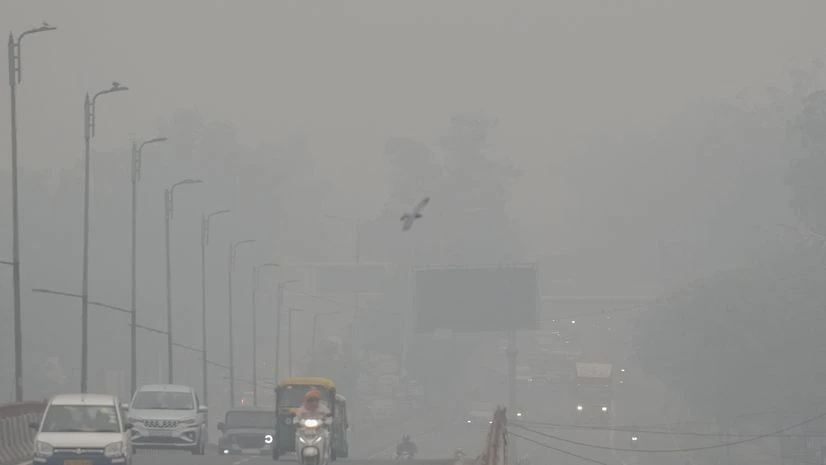
Visuals from across Delhi show a thick layer of toxic smog enveloping the city, with the average Air Quality Index (AQI) recorded at 373, placing it in the ‘very poor’ category.
The AQI at Ghazipur on NH-24 stood at 368, also classified as ‘very poor’, according to the Central Pollution Control Board (CPCB). Similar conditions were observed at Indira Gandhi International Airport, where the AQI was recorded at 368.


Images from ITO and Anand Vihar show the national capital shrouded in dense smog. In response, the Commission for Air Quality Management (CAQM) has invoked all actions under GRAP Stage-IV across Delhi-NCR, with an AQI of 374 recorded around ITO and Anand Vihar.
Despite the smog, Republic Day parade rehearsals at India Gate are continuing, where the AQI was recorded at 354, also categorised as ‘very poor’ by CPCB.
Meanwhile, the Delhi Cabinet, on Tuesday, approved a series of major initiatives aimed at strengthening the capital’s fight against pollution and improving environmental governance, according to a press release.
Announcing the outcomes, Environment Minister Manjinder Singh Sirsa said these measures would bring “a decisive reduction in sources of air and water pollution, while creating a cleaner, more sustainable urban environment.” The Cabinet approved an allocation of Rs. 100 crore for rejuvenating water bodies under the Delhi government. Out of approximately 1,000 water bodies in Delhi, 160 fall under the Delhi Government’s domain.
Sirsa stated, “The rejuvenation of Delhi’s water bodies will play a crucial role in pollution control. The Chief Minister has directed that every possible financial support be extended to complete this work within the year.”
Earlier, the Delhi Pollution Control Committee (DPCC) had provided Rs. 19 crore for this initiative. With the additional Rs. 100 crore, the government aims to achieve 100 per cent rejuvenation of all identified water bodies. Follow-ups will also be made with the Delhi Development Authority (DDA) to ensure similar action on their part.
The Cabinet also approved the establishment of Delhi’s first E-Waste Park at Holambi Kalan, covering 11.5 acres, which will follow best pollution norms and operate on a 100 per cent circular, zero-waste model.
“This will be India’s first state-of-the-art e-waste facility built on zero pollution and zero wastage principles. The plant will fully recycle and reuse water through an advanced recirculation mechanism,” Sirsa added. (Agencies)