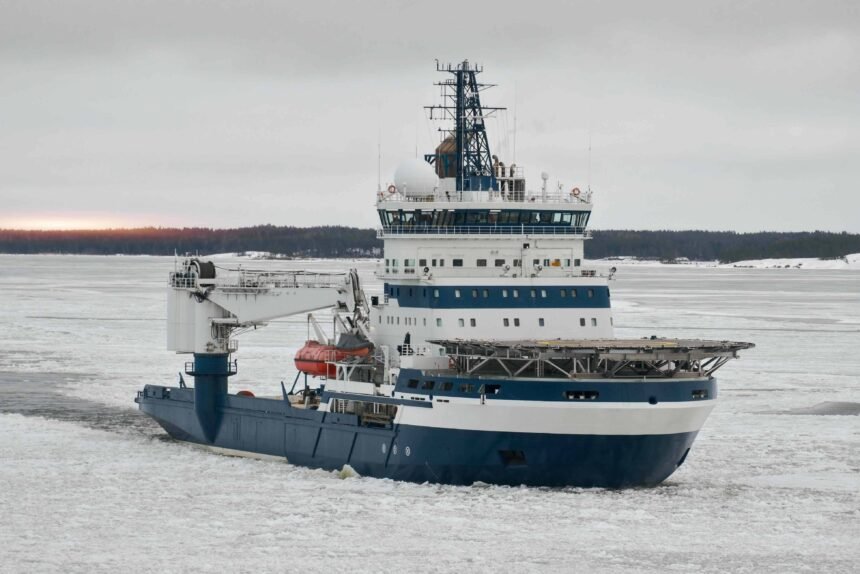
“World’s Best Icebreakers’: Why the US is Buying from Finland”
As President Donald Trump continues to insist that the US needs to own Greenland, his broader focus on the Arctic has led Washington to order new icebreakers.


These vessels, designed to sail through solid ice, are being sourced from the global experts – Finland.
At Aker Arctic Technology’s ice laboratory in Helsinki, scale models of icebreakers are tested in a 70-meter-long simulation tank, carving precise channels through frozen water. Engineers emphasize that structural strength, engine power, and hull design – which bends ice downward rather than slicing – are crucial for performance.
Finland is the undisputed leader in icebreaker technology. Finnish companies have designed 80% of all operational icebreakers, with 60% built in domestic shipyards. The country relies on these ships to keep ports open during harsh winters, ensuring the steady flow of goods, 97% of which arrive by sea.
Trump announced in October that the US would order four icebreakers from Finland for the Coast Guard. An additional seven “Arctic Security Cutters” will be built in the US using Finnish designs and expertise. “We’re buying the finest icebreakers in the world, and Finland is known for making them,” Trump said.
Under US law, naval and coastguard ships must normally be built domestically. However, Trump waived this requirement on national security grounds, citing “aggressive military posturing and economic encroachment by foreign adversaries,” referring to Russia and China.
The US is expanding its icebreaker fleet as climate change opens Arctic shipping routes and makes previously inaccessible oil and gas fields reachable. “There’s simply a lot more traffic in that part of the world now,” notes Peter Rybski, a retired US Navy officer and Arctic expert.
Following Trump’s announcement, Finland’s Rauma Marine Constructions was contracted to build two icebreakers, with the first ship expected in 2028. Four more will be built in Louisiana, all using Finnish Aker Arctic Technology diesel-electric designs.
The US move aims to catch up with Russia, which currently operates around 40 icebreakers, including eight nuclear-powered vessels. By comparison, the US has only three, while China operates around five polar-capable ships, though none meet strict icebreaker standards.
Experts note that icebreakers serve not only practical purposes but also as symbols of Arctic influence. “You can’t sail an aircraft carrier into the central Arctic Ocean, but icebreakers signal Arctic capabilities,” says Lin Mortensgaard from the Danish Institute of International Studies.
In Finland, Helsinki Shipyard, where half the world’s icebreakers have been built, continues construction on the latest heavy-duty Arctic vessel, Polarmax, destined for Canada. With over a century of experience, Finnish designers, operators, and builders are regarded as the superpower of icebreakers. ( Agencies)