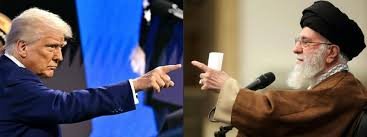
Tehran on Edge as Trump Sets 15-Day Ultimatum, Military Strike Option Looms
Tensions between Washington and Tehran have escalated sharply after former US President Donald Trump issued a 15-day deadline, warning that failure to comply with American demands could trigger decisive action — including a potential military strike.
Iranian officials are reportedly reviewing diplomatic and strategic options in response to what they describe as a serious and time-bound ultimatum. Sources indicate that Tehran is weighing a combination of political messaging, regional coordination, and possible countermeasures as the clock ticks down.
The announcement has heightened concerns of renewed confrontation in the Middle East, with global observers closely monitoring developments. While Washington has kept the strike option “on the table,” analysts say the coming days will be critical in determining whether the standoff moves toward negotiations or further escalation.
Diplomatic channels are believed to be active behind the scenes, but neither side has publicly indicated signs of compromise. As uncertainty grows, markets and regional allies are bracing for potential fallout from any dramatic shift in US-Iran relations.
What Congress Says on Trump’s Repeated Threats to Tehran
Iran–US Tensions Updates: Several US lawmakers have raised concerns over former President Donald Trump’s recent remarks suggesting possible military action against Iran, arguing that Congress must authorise any such move before strikes are carried out.
Democratic Senator Tim Kaine of Virginia said on Friday that he has introduced a war powers resolution requiring the president to seek congressional approval prior to launching military action against Tehran.
Kaine acknowledged that the resolution faces long odds of becoming law, particularly because it would require Trump’s signature.
“If some of my colleagues support war, then they should have the guts to vote for the war, and to be held accountable by their constituents, rather than hiding under their desks,” Kaine said in a statement cited by the Associated Press.
However, not all lawmakers agree. Some members of Congress have opposed the resolution, arguing that it could limit the United States’ ability to respond swiftly to emerging threats and potentially weaken deterrence if Iran continues actions seen as destabilising in the region.
What Tehran and Washington Are Negotiating
US President Donald Trump has indicated that he believes 10 to 15 days is “enough time” for Iran to reach an agreement, despite limited visible progress in recent indirect negotiations, including talks held this week in Geneva.
The diplomatic process has remained stalled for years, particularly after Trump’s 2018 decision to withdraw the United States from the 2015 nuclear deal between Iran and major world powers. Following that move, Tehran has resisted broader US and Israeli demands, including restrictions on its missile programme and its regional alliances.
Iran’s Foreign Minister Abbas Araqchi said Friday that American negotiators did not demand zero uranium enrichment in the latest round of talks — a claim that contrasts with public statements made by US officials.
“What we are now talking about is how to make sure that Iran’s nuclear program, including enrichment, is peaceful and will remain peaceful forever,” Araqchi said, according to AP. He added that Iran would be open to certain confidence-building measures in exchange for relief from economic sanctions.
A White House official, speaking on condition of anonymity, disputed that account and reiterated Trump’s firm stance: Iran must not possess nuclear weapons, must not have the capability to build them, and must not enrich uranium.
Tehran has consistently maintained that discussions should remain limited to its nuclear programme. Iranian officials have also stated that the country has not enriched uranium since US and Israeli strikes targeted Iranian nuclear facilities last June.
As diplomatic efforts continue under mounting pressure, both sides remain publicly firm, leaving the outcome of the standoff uncertain.
What Trump Said on the 10–15 Day Deadline
Iran–US Tensions Updates: US President Donald Trump has issued a strong warning to Iran amid ongoing nuclear negotiations, saying Tehran has roughly 10 to 15 days to reach an agreement or face consequences.
“We’re either going to get a deal, or it’s going to be unfortunate for them… 10–15 days would be enough time,” Trump told reporters.
Speaking at the inaugural “Board of Peace” meeting, he reiterated that Iran must commit to what he described as a “meaningful deal” on its nuclear programme. He also hinted that if diplomacy fails, the United States may escalate its response.
“Now we may have to take it a step further, or we may not,” Trump said, indicating that the military option remains under consideration.
He further stressed that Iran must stop actions seen as destabilising the region and negotiate in good faith, adding that the situation would likely become clearer within the next 10 days.
India Monitoring Developments
Amid rising tensions between Washington and Tehran, India said it is closely monitoring the situation. The Ministry of External Affairs (MEA) confirmed on Friday that it is tracking developments carefully.
Official spokesperson Randhir Jaiswal said during the weekly briefing, “We are keeping an eye on the situation and staying in constant touch with the Indian community living there (in Iran).”
Trump ‘Considering’ Limited Military Action
Trump also acknowledged that limited military action remains a possibility even as talks continue.
When asked whether the US could conduct limited strikes during negotiations, he responded, “I guess I can say I am considering that.”
His remarks came shortly after Iran’s Foreign Minister Abbas Araqchi said in a television interview that Tehran was working to finalise a draft agreement within “the next two to three days,” which would then be sent to Washington for review.
US Congress May Vote on Limiting Strike Powers
According to Reuters, the US Congress could vote as early as next week on a proposal to restrict Trump’s authority to launch military strikes against Iran without lawmakers’ approval. The debate comes as the US military prepares contingency plans in case diplomatic efforts collapse.
Several lawmakers — including some Republicans aligned with Trump as well as Democrats — have previously introduced resolutions aimed at curbing presidential war powers. However, such efforts have not succeeded so far.
Under the US Constitution, the authority to declare war lies with Congress, except in cases involving limited military action justified on national security grounds.
Deal Possible ‘Very Soon’, Says Araqchi
Despite the escalating rhetoric, Abbas Araqchi expressed optimism that a diplomatic breakthrough could be achieved “in a very short period of time,” according to Reuters.
Although he did not provide a specific timeline for formally presenting Iran’s counterproposal to US officials, he suggested that progress could be made quickly if talks continue along the current trajectory.