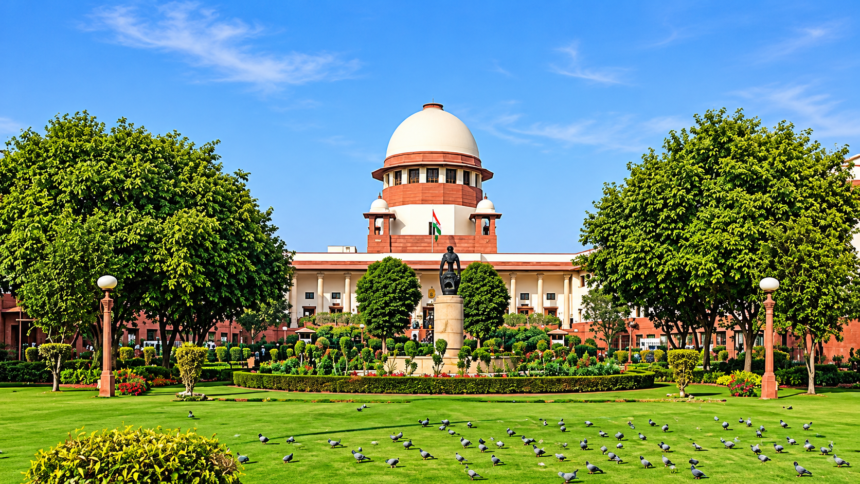
New Delhi, November 5: The Supreme Court of India on Thursday delivered a significant ruling on the constitutional rights of arrested persons, holding that the mandatory 24-hour period for producing an individual before a magistrate begins from the moment of actual detention, and not from the time the police formally records the arrest.
A Bench comprising Justices Ujjal Bhuyan and Atul S. Chandurkar ruled that authorities cannot create an artificial distinction between detention and formal arrest to bypass constitutional safeguards under Article 22(2) of the Constitution.


The court observed that any interpretation allowing investigating agencies to exclude the period of detention before formal arrest would be contrary to the constitutional mandate.
The Supreme Court clarified that time spent in inquiry, investigation, search or seizure before formal arrest must also be counted towards the 24-hour deadline. The only permissible exclusion is the time reasonably required to travel from the place of arrest to the magistrate’s court.
The Bench further held that any person detained beyond the permissible 24-hour period without being produced before a magistrate must be released forthwith.
It also directed magistrates to record the actual date and time of detention and independently examine whether constitutional requirements have been followed. Magistrates may also refuse remand if the period of detention is found to be unreasonable.
The ruling came in a case involving four accused persons who challenged a Tripura High Court decision denying them bail in an NDPS case. The Supreme Court found that their detention had exceeded the constitutional deadline and ordered their immediate release.
The judgment reinforces the constitutional protection of personal liberty and seeks to prevent investigating agencies from delaying formal arrest records to extend custody without judicial oversight.
The detailed judgment is awaited.