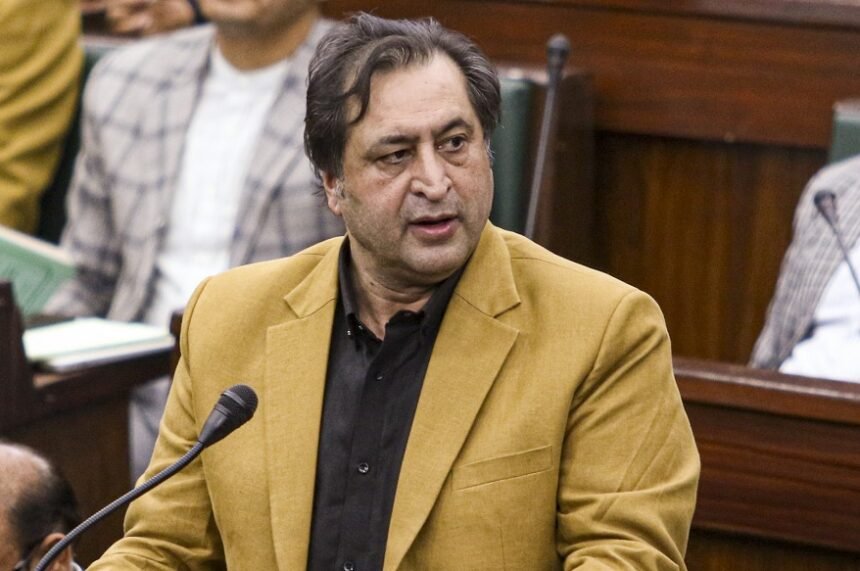
Jammu, March 30: Peoples Conference President and Handwara MLA Sajad Lone on Monday raised serious concerns in the Jammu and Kashmir Legislative Assembly over what he described as glaring inconsistencies in defining economic vulnerability across government departments, terming it a “structural flaw” that is skewing fairness in jobs and welfare distribution.
Anchoring his argument in official data, Lone pointed out that the Food Department classifies nearly 39 lakh people in Kashmir and around 27 lakh in Jammu as poor under the BPL and AAY categories. However, he noted that the Social Welfare framework presents a sharply contrasting picture, suggesting that nearly 90% of the population in Jammu falls under the economically weaker category, compared to just 10% in Kashmir.


Calling the contradiction more than a statistical anomaly, Lone termed it a policy failure with tangible consequences. He argued that such inconsistencies are distorting access to the Economically Weaker Sections (EWS) quota, particularly in recruitment processes.
Referring to recent selections, including judicial and KAS recruitments, Lone said the scale of disparity being witnessed is unprecedented. “This is something not seen since 1947,” he remarked, asserting that Kashmir is being systematically disadvantaged due to conflicting definitions of poverty.
“What kind of governance is this,” Lone questioned on the Assembly floor, “where a person is considered poor while receiving rations or subsidies, but suddenly becomes ‘economically ineligible’ when applying for a job?”
He further warned that with around 30,000 government jobs in the pipeline, the current EWS framework could leave Kashmir with only a negligible share—possibly fewer than 100 positions—despite ground data indicating otherwise.
Drawing a comparison, Lone said that BPL figures suggest a more balanced 60:40 distribution in favour of Kashmir, and cited examples of states like Kerala, which have attempted to rationalize EWS criteria by aligning them with existing poverty indicators.
Rejecting the need for a complete legislative overhaul, Lone instead called for administrative coherence. “One government must have one definition,” he asserted, emphasizing that uniformity in policy, rather than expansion of legal frameworks, is essential to ensure equity and justice.
His remarks have once again brought the spotlight on the complexities surrounding EWS implementation in Jammu and Kashmir, with calls growing louder for a unified and transparent framework across departments.