April 18, 2026
Jammu/Srinagar:
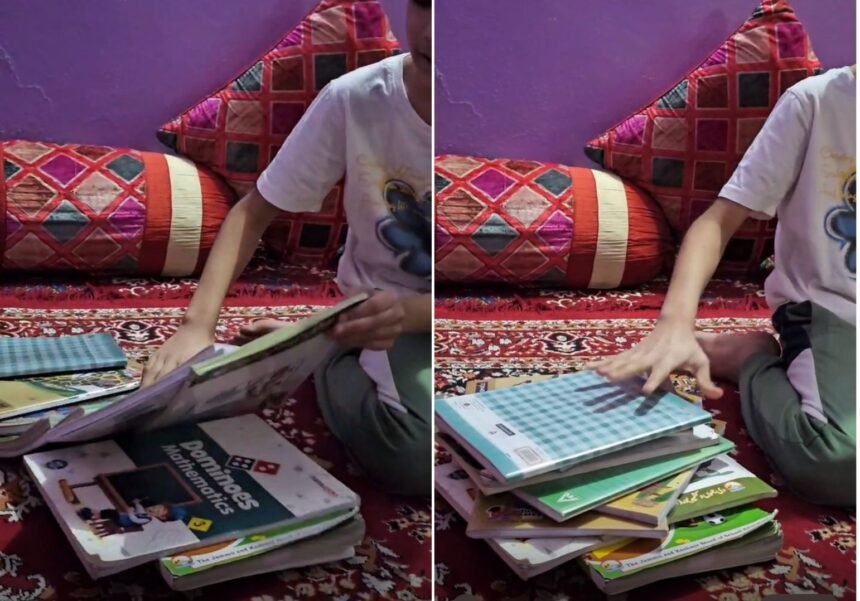
Despite repeated government directives and court-backed guidelines, private schools across Jammu & Kashmir are facing mounting criticism for allegedly continuing practices that burden students with heavy school bags and compel parents to purchase costly, school-specific book sets from designated vendors.

Parents from several districts, including Jammu, Srinagar, Ramban, Doda, and Kishtwar, have reported that children—particularly in primary classes—are being forced to carry an excessive number of books, many of which are privately published and not part of the standard curriculum.
The Jammu and Kashmir School Education Department has, over the years, issued multiple circulars regulating school bag weight and book prescriptions. These directions align with national norms recommending that a school bag should not exceed 10% of a child’s body weight.
Authorities have also advised schools to limit the number of textbooks, avoid unnecessary supplementary material, and follow standard curriculum-based books, particularly those prescribed by the National Council of Educational Research and Training.
However, parents allege that many private institutions continue to prescribe additional private publications, significantly increasing both academic load and physical burden.
A major grievance among parents is the alleged compulsion to purchase books and stationery from specific shops identified by school managements.
“Each school has its own set of books, and they are available only at one or two designated shops. We are left with no choice,” said a parent from Jammu.
Such practices directly contradict CBSE norms and judicial rulings, which clearly state that schools cannot force parents to buy materials from particular vendors.
The Madras High Court, while hearing a case in 2018, observed that children are often forced to carry unnecessary books, resulting in bags weighing far beyond prescribed limits. It highlighted that international standards recommend that school bag weight should not exceed 10% of a child’s body weight, yet in reality, bags often weigh significantly more.
Similarly, the Delhi High Court and various state governments have issued guidelines fixing maximum permissible weight for school bags across different classes.
However, ground reports suggest that these norms are widely ignored, primarily due to the excessive number of books—many of which are privately published and non-essential.
Judicial observations across India have consistently emphasized that there should be no compulsory purchase from school-run or designated shops, that transparency must be maintained in book lists, and that profiteering in education must be avoided. These principles are considered applicable across all states and Union Territories, including Jammu & Kashmir.
Education activists argue that the trend reflects growing commercialisation in the private school sector. Instead of relying on affordable NCERT books, many schools prescribe high-priced private publications, often revised annually, forcing parents to spend thousands of rupees each academic session.
“This system benefits select publishers and vendors, not students,” said an education activist in Srinagar.
The consequences of these practices are increasingly visible. Health concerns are rising, with heavy school bags contributing to back pain and posture-related issues among children. Families are facing financial stress due to the high annual cost of books and materials, while students are under academic pressure to manage excessive study content. Experts also warn that such practices deepen inequality, disproportionately affecting students from economically weaker sections.
With complaints mounting, parents and civil society groups are urging the administration to take strict action against violators. They are calling for enforcement of school bag policies through regular inspections, a ban on vendor-specific book sales, mandatory use of NCERT books for core subjects, and penalties for schools found violating norms. There are also demands for routine checks of students’ school bags to ensure compliance.
Residents say the situation in Jammu & Kashmir reflects a broader national concern where regulations exist on paper but lack strict enforcement on the ground. As schools reopen for the new academic session, the spotlight is once again on authorities to ensure that children are not overburdened—physically or financially—in the name of education.
Unless timely intervention is made, the cycle of heavy school bags and costly, restricted book systems is likely to persist, affecting thousands of students across the Union Territory.