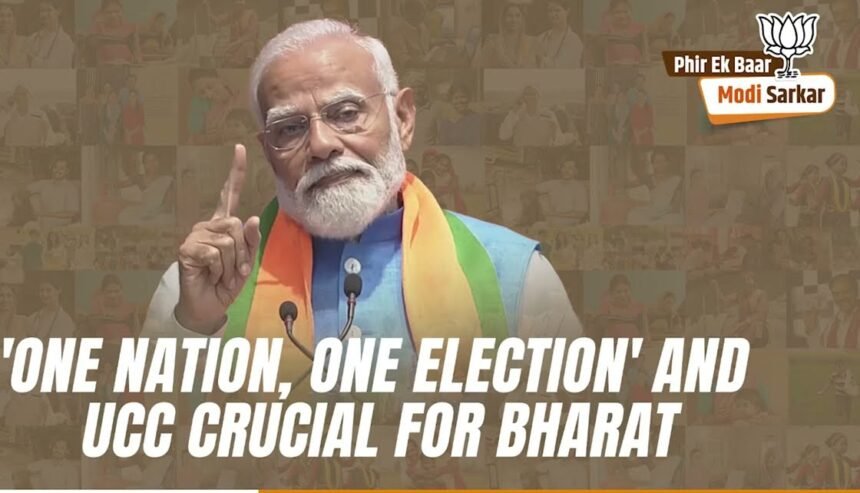
New Delhi, April 6: Prime Minister Narendra Modi on Monday highlighted the Bharatiya Janata Party’s (BJP) efforts to transform Indian politics, focusing on initiatives like the Uniform Civil Code (UCC) and One Nation One Election (ONOE) as part of the party’s “service-oriented” approach.
Addressing BJP workers via video conferencing on the party’s 47th foundation day, PM Modi underlined the party’s achievements, pointing to reforms and initiatives that, he said, demonstrate the BJP’s commitment to governance and nation-building.


“The abolition of hundreds of colonial-era laws, construction of a new Parliament building, 10 percent reservation for the underprivileged, the triple talaq ban, CAA, and the Ram temple in Ayodhya… these are the results of BJP’s honest efforts. Our mission is still ongoing,” he said.
He highlighted the party’s future agenda, stating, “Serious discussions today on topics like Uniform Civil Code and One Nation One Election reflect our dedication to national integration and efficient governance. Our goal is to build a developed, self-reliant India, and we will continue working selflessly to achieve it.”
PM Modi also emphasized the party’s journey, saying, “In a few years, BJP will complete fifty years. This is a huge milestone and inspiration. We must set new goals and embrace the era of changing technology. I extend my best wishes to our crores of workers on BJP Foundation Day.”
He asserted that the BJP has introduced the principle of “Nation First” in Indian politics, contrasting it with past Congress regimes, including the 1984 period, which, according to him, betrayed public trust.
“Two streams became clear in the country’s politics. One became power-based politics, the other service-based politics. Congress always gave importance to one family, whereas BJP respects everyone equally,” he added.
PM Modi also praised the party’s diplomacy: “There was a time when India kept a distance from many nations, but today India builds relations with all nations.”
The Bharatiya Janata Party traces its roots to the Jana Sangh, which merged with the Janata Party after the Emergency in 1977 to defeat Congress. Following disputes over dual membership with the RSS, the Jana Sangh members left the Janata Party and founded the BJP on April 6, 1980.
Since its formation, the BJP has produced two Prime Ministers: Atal Bihari Vajpayee and Narendra Modi. (Agency)