Party leaders pointed out that despite West Bengal being rich in natural and human resources, its per capita income remains among the lowest in the country.


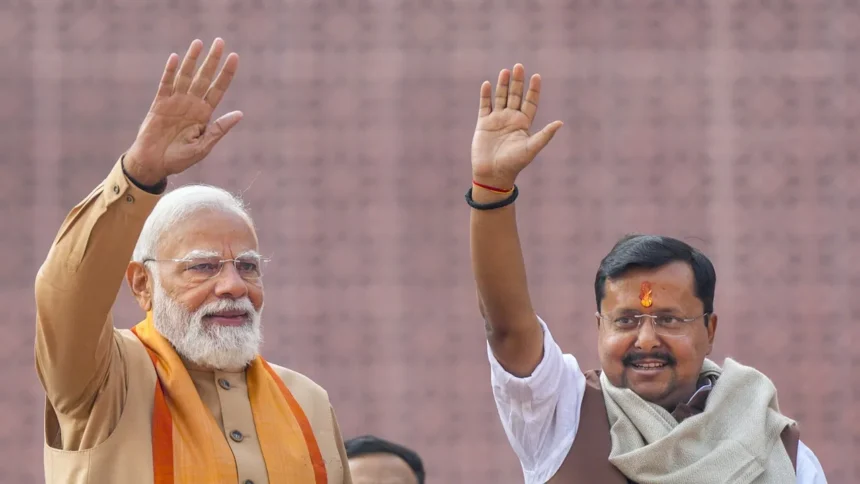
Newly appointed Bharatiya Janata Party national president Nitin Nabin has moved quickly to signal his priorities, convening his first major organisational meeting with West Bengal leaders and election-focused workers to chart a detailed roadmap for the upcoming Assembly polls.
Sources said the meeting focused sharply on governance failures in the state and on building a constituency-wise campaign aimed directly at the Trinamool Congress’s record over the past 15 years.
West Bengal’s economic distress was placed at the centre of the BJP’s campaign strategy. Party leaders highlighted that despite the state’s resource potential, ordinary citizens continue to face low income levels. According to those present, the leadership stressed the need to communicate this contradiction to voters, projecting it as a result of policy paralysis and mismanagement under the TMC government.
Health infrastructure emerged as another key concern. BJP leaders pointed to the near collapse of primary health centres, an acute shortage of doctors in government hospitals, lack of medicines and unhygienic conditions. The meeting noted that these shortcomings have generated strong resentment at the grassroots, particularly in rural and semi-urban areas, and should be highlighted through sustained local campaigns.
The education sector was also discussed at length, with the leadership flagging what it described as a steady decline in standards and opportunities for students.
Women’s safety featured prominently, with the party describing West Bengal as increasingly unsafe for women and citing a rise in crimes along with alleged administrative apathy. Leaders agreed that the issue cuts across social groups and must be addressed with sensitivity and consistency.
Concerns related to migrant labourers and the challenges they face both within and outside the state were also deliberated upon. Law and order was described as being in a state of breakdown, with repeated references to what the BJP termed “jungle raj” conditions. The party also reiterated its long-standing allegation of minority appeasement by the ruling dispensation, arguing that it has widened social fault lines and weakened governance.
On political messaging, the BJP decided to approach voters with a clear promise to identify and remove illegal infiltrators. Sources said the leadership believes the issue resonates across both border districts and urban centres and will form a key pillar of the campaign.
A major organisational decision taken under Nitin Nabin’s leadership is the preparation of a detailed chargesheet for every Assembly constituency in West Bengal. These documents will list local-level failures of the TMC government, ranging from infrastructure gaps to civic issues.
Senior BJP leaders will publicly release these chargesheets at rallies, followed by door-to-door outreach to ensure they reach households. The aim, sources said, is to directly hold each sitting MLA accountable for the condition of their constituencies over the past decade and a half.
The leadership assessed that visible anger already exists against several local legislators and that this sentiment must be channelled into a structured political narrative. By targeting individual MLAs rather than abstract governance failures, the BJP hopes to localise the election and convert dissatisfaction into votes.
The meeting also finalised the slogan “Paltano darkar, chayee BJP sarkar” as the central theme of the campaign. The slogan, earlier used by Prime Minister Narendra Modi at a public meeting in Malda, will be amplified through rallies, outreach programmes and a campaign song released by the party.
Slogan-driven campaigns have long shaped West Bengal’s political contests. In the previous Assembly elections, the Trinamool Congress rallied around “khela hobey,” while the BJP responded with counter-slogans focused on governance and corruption. The new call for change seeks to build on that tradition, framing the election as a clear choice before the electorate. (Agencies)