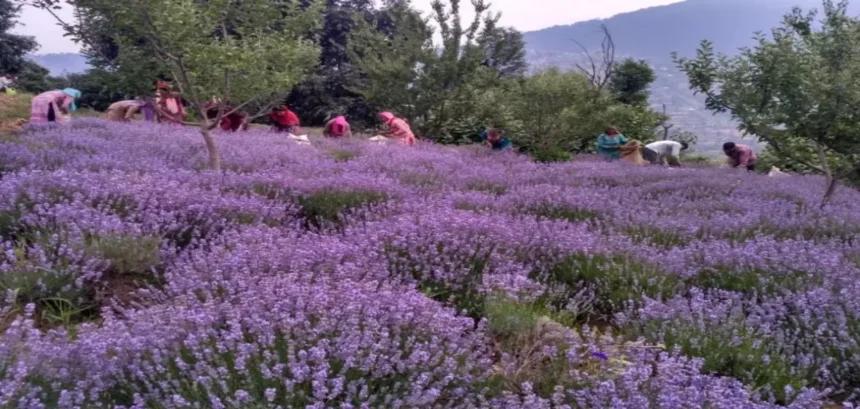
BHADERWAH (J&K), Feb 21: In a major boost to lavender cultivation, around six lakh free quality planting material (QPM) seedlings were distributed among 750 farmers across Jammu & Kashmir and Uttarakhand, officials said on Saturday.
The initiative aims to expand cultivation of the exotic aromatic crop, increase farmers’ income, and strengthen the region’s reputation as a hub for lavender production in India, said Sandeep Singh Charak, Lavender Scientist at CSIR-IIIM Jammu.


Charak added that the seedlings were distributed over the past few days at 50 nurseries in Bhaderwah, widely recognised as the birthplace of India’s “Purple Revolution.” “IIIM Jammu has procured and distributed six lakh lavender seedlings among 400 farmers in Uttarakhand and 350 farmers in Bhaderwah, Doda, and the twin border districts of Rajouri and Poonch in Jammu & Kashmir,” he said, adding that the process is ongoing and more farmers will receive seedlings this season.
Touqeer Bagban, a progressive farmer and entrepreneur known as the ‘Lavender Man of India,’ said the distribution is a major boost for lavender growers. He has successfully motivated 2,500 farmers to switch from traditional maize cultivation to aromatic lavender.
“The CSIR-IIIM not only purchased six lakh seedlings from nursery owners but also distributed them free to new farmers who want to transition to lavender cultivation,” Bagban said, crediting the success to the personal efforts of Union Minister Jatinder Singh.
He added that the shift to lavender has significantly increased farmers’ incomes, from roughly Rs 40,000–60,000 per hectare to over Rs 3.5–6 lakh per hectare.
Charak noted that lavender is low-maintenance, drought-resistant, and animal-resistant, making it ideal for hilly regions. Once established, it provides returns for about 15 years after the first two years of growth.
The programme has grown substantially, with over 30 lakh free plants distributed to farmers so far, and it has now expanded beyond J&K to other states, including Uttarakhand, Himachal Pradesh, and the north-eastern region. (Agencies)