Asif Iqbal Naik
Jammu January 2; 2026:
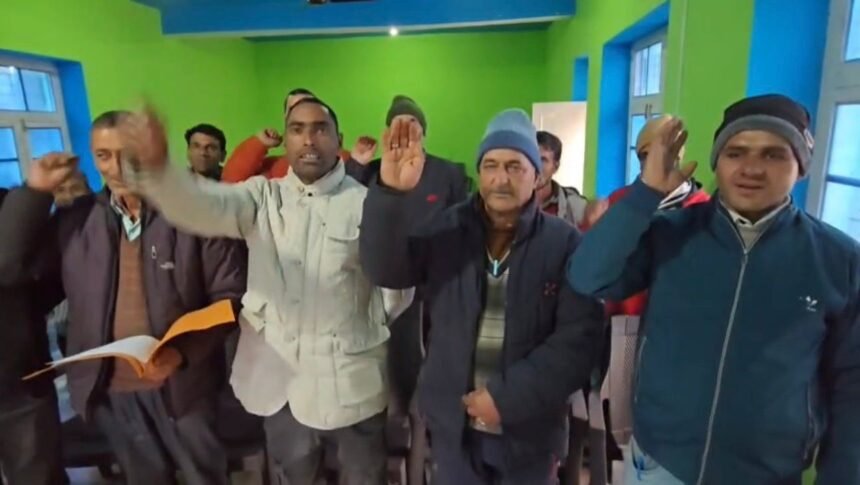
Lambardars and Chowkidars from Bhlesa area of Doda district have voiced serious concern over what they describe as the continued neglect of their long-standing services, a grievance they say resonates across the entire Union Territory of Jammu & Kashmir. The representatives said that despite serving as the backbone of village-level administration since 1947, their socio-economic condition has only deteriorated with time.

They pointed out that at present Chowkidars are paid a meagre honorarium of ₹1,500, while Lambardars receive around ₹1,501 in J&K—an amount they termed grossly inadequate to meet even basic household needs in the face of rising inflation. The representatives said this situation has pushed many Lambardars and Chowkidars into financial distress, despite their crucial role in governance at the grassroots.
Highlighting the pan J&K dimension of the issue, they stated that Lambardars and Chowkidars across districts—from remote hilly regions to plains—are engaged in work related to nearly 34 government departments. Their responsibilities include revenue-related tasks, verification work, disaster response, election duties, law and order assistance, census activities, and acting as the first link between the administration and the public, often working round the clock without fixed duty hours.
The representatives lamented that repeated appeals to successive governments for a comprehensive policy, clear definition of duties, social security benefits, and enhancement of honorarium have yielded no tangible results. They said the absence of a structured framework has led to overburdening, role ambiguity, and exploitation of their services without commensurate compensation.
Calling upon the government to take urgent cognizance, Lambardars and Chowkidars urged the administration to acknowledge their vital contribution to governance and public service in Jammu & Kashmir. They demanded the framing of a proper policy, rationalization of duties, and payment of at least minimum basic wages to ensure a dignified livelihood, stressing that strengthening grassroots functionaries is essential for effective administration and public welfare across J&K.
They also drew attention to the Minimum Wages Act, stating that the spirit of the law mandates payment of wages sufficient to ensure a basic and dignified standard of living for any worker engaged by the state or its agencies. The representatives argued that although Lambardars and Chowkidars are paid in the form of “honorarium,” the nature, volume, and continuity of their work—spread across nearly 34 government departments—clearly amounts to regular public service. They demanded that their honorarium be merged with wages at par with notified minimum wages, with periodic revision in line with inflation and cost of living indices, asserting that continuing with token amounts violates both the intent of labour laws and the principles of social justice.