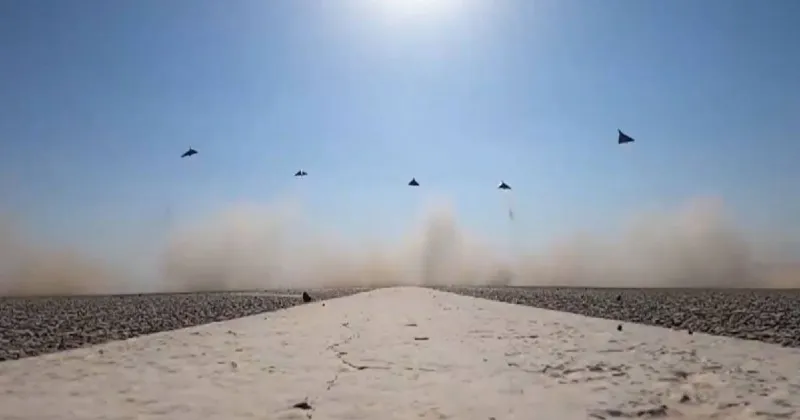
Tehran, March 14: New video footage has captured what officials described as the moment Islamic Revolutionary Guard Corps (IRGC) Aerospace Force launched a swarm of drones at United States–Israel positions, offering a detailed glimpse of a coordinated aerial offensive reportedly initiated from a remote desert facility.
The visuals, shared on X and Telegram by Iranian state broadcasters, show several delta-wing drones lined up along a paved runway under bright daylight.
After ignition, the drones launch almost simultaneously, producing bright orange flashes from their boosters and kicking up dense clouds of dust and sand.
As the sequence continues, the drones can be seen rapidly ascending into the sky, leaving thick white smoke trails behind them.
The footage later shows the aircraft flying in tight formation across the horizon, moving away from the launch site as part of the reported swarm deployment.
Earlier, another state media outlet released visuals showing part of the IRGC’s drone arsenal inside a large underground tunnel facility.
Coinciding with the release of the footage, the IRGC confirmed the launch of the 48th phase of its retaliatory campaign under Operation True Promise 4.
In a statement issued on Saturday, the Corps said it had “successfully carried out the 48th wave of its ongoing retaliatory operation against Zionist and American targets.”
The offensive was reportedly conducted in coordination with Hezbollah, the Lebanese resistance group.
Military officials said the primary targets inside the occupied territories were located in the northern sector, particularly in Galilee, Golan Heights, and the coastal city of Haifa.
In addition to these areas, several American military bases across the region were also reportedly targeted during the latest phase of the conflict.
According to Press TV, the 48th wave involved a combination of advanced weaponry, including solid-fuel Kheibar Shekan missile, liquid-fuel Qadr missile, and attack drones.
This followed the completion of the 47th wave, which took place on Friday.
During that phase, targets reportedly included strategic locations in the Negev Desert, including Nevatim Airbase, one of the largest airbases in the region.
Other reported targets included Be’er Sheva, described as a major technological hub, and the city of Lod.
The IRGC also claimed to have struck Al Udeid Air Base, described as the most significant United States military base in the West Asia region.
The operation also targeted hideouts of the anti-Iran Komala, using both Kheibar Shekan and Qadr missiles.
Press TV reported that during the 46th wave, also carried out on Friday, the IRGC deployed Khorramshahr missile, Kheibar Shekan, Emad missile, and Qadr missiles.
Highlighting the impact of the attacks, the Corps said the strikes had created widespread alarm, stating that sirens were sounding repeatedly and civilians were rushing to shelters.
Since the escalation of hostilities late last month, the IRGC claims it has deployed hundreds of ballistic and hypersonic missiles along with numerous attack drones.
On the defensive front, Iranian forces said they shot down five incoming aircraft on Friday, including Orbiter 4, Hermes drone, and the MQ-9 Reaper.
Military data cited by state media also indicated that a total of 114 reconnaissance and combat drones have been intercepted by Iran’s air defence systems since the beginning of the conflict.
In a further escalation of psychological messaging, the IRGC reportedly began sending Hebrew text messages to residents in the occupied territories warning of continued attacks.
The message reportedly stated that “days of darkness” were ahead and that people would wish for death but would not find it. (Agency)