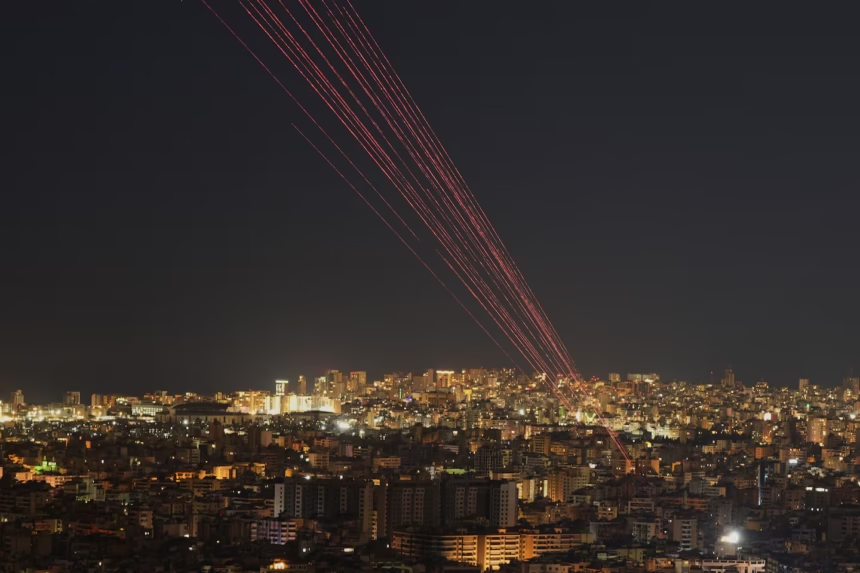
Dubai, Mar 5: Iran launched a new wave of attacks Thursday morning on Israeli and American bases, following threats to destroy military and economic infrastructure across the region. The strikes came after the US and Israel intensified their bombardment of Iran, and a US Navy submarine sank an Iranian warship in the Indian Ocean.
Israel reported multiple incoming missile attacks, with air sirens sounding in Tel Aviv and Jerusalem. Iranian state television confirmed that US bases were also targeted. In response, the Israeli military carried out targeted strikes in southern Beirut, Lebanon, hitting positions of the Iranian-backed Hezbollah militant group.


The US and Israel began the conflict on Saturday, targeting Iran’s leadership, missile arsenal, and nuclear program. While toppling the Iranian government was suggested as a possible goal, officials have repeatedly indicated that the timeline and objectives remain open-ended.
The intensity of the strikes on Wednesday was such that Iranian state television postponed the mourning ceremony for Supreme Leader Ayatollah Ali Khamenei, who was killed at the start of the conflict. Millions had attended the funeral of his predecessor, Ayatollah Ruhollah Khomeini, in 1989.
US President Donald Trump praised the military’s efforts, while Republicans in the Senate rejected a resolution seeking to halt the war.
The conflict has spread to multiple countries. Iran fired missiles toward Bahrain, Kuwait, and Israel. Turkey reported intercepting a ballistic missile launched from Iran before it entered Turkish airspace.
Officials say more than 1,000 people have been killed in Iran, over 70 in Lebanon, and around a dozen in Israel. The conflict has disrupted global oil and gas supplies, affected international shipping, and stranded hundreds of thousands of travelers in the region.
Escalating Regional Threats
Countries across the Middle East braced for further danger after Iran’s Revolutionary Guard threatened “the complete destruction of the region’s military and economic infrastructure.” Qatar evacuated residents near the US Embassy in Doha as a precaution. Fighter jets were reported over Dubai, and Saudi Arabia destroyed a drone near its border with Jordan.
A new attack off Kuwait’s coast raised concerns for commercial shipping. The UK Maritime Trade Operations Centre reported an explosion early Thursday, possibly involving a tanker. Past attacks have targeted the Gulf of Oman and the Strait of Hormuz, through which about a fifth of the world’s oil is shipped. Brent crude prices have surged 15% since the conflict began, reaching their highest level since July 2024.
Targeted Strikes on Iranian Military
US Defense Secretary Pete Hegseth confirmed a US submarine sank an Iranian warship Tuesday night in the Indian Ocean. Sri Lankan authorities rescued 32 crew members and recovered 87 bodies. Israel struck buildings tied to Iran’s internal security and the Basij paramilitary force, responsible for violent crackdowns on protesters in January.
Iranian Foreign Minister Abbas Araghchi stated that Iran’s forces operate in a decentralized manner, potentially limiting the impact of attacks on command centers.
Shifting Timelines for US Operations
Hegseth did not provide a definite timeline for US operations, though Trump suggested they could last a month or more. US and Israeli officials said Iranian missile launches have decreased as key targets, including ballistic missiles and drones, were destroyed. Israel eased some domestic restrictions, reopening workplaces with nearby shelters, though schools remain closed.
Explosions continued in Israel early Thursday, with defenses intercepting multiple waves of missiles. As of Wednesday, 1,045 people had died in Iran, 11 in Israel, six US troops, and at least eight in Lebanon, including three in southern Beirut during Israeli drone strikes.
Israel’s Preplanned Offensive
Israeli Defense Minister Israel Katz said the offensive against Iran was originally planned for mid-2026 but was accelerated due to evolving threats, Trump’s stance, and potential coordinated operations with the US.
Iran Prepares New Leadership
Iran is choosing a new supreme leader following Khamenei’s death, only the second transition since the 1979 Islamic Revolution. Candidates include hard-liners favoring confrontation with the West and reformists seeking diplomatic engagement. Mojtaba Khamenei, the late leader’s son, is considered a potential candidate.