Chief Minister Omar Abdullah on Wednesday emphasised the crucial role of the Tele-Law initiative in expanding access to justice and easing the burden on courts, particularly for citizens in rural and remote areas.
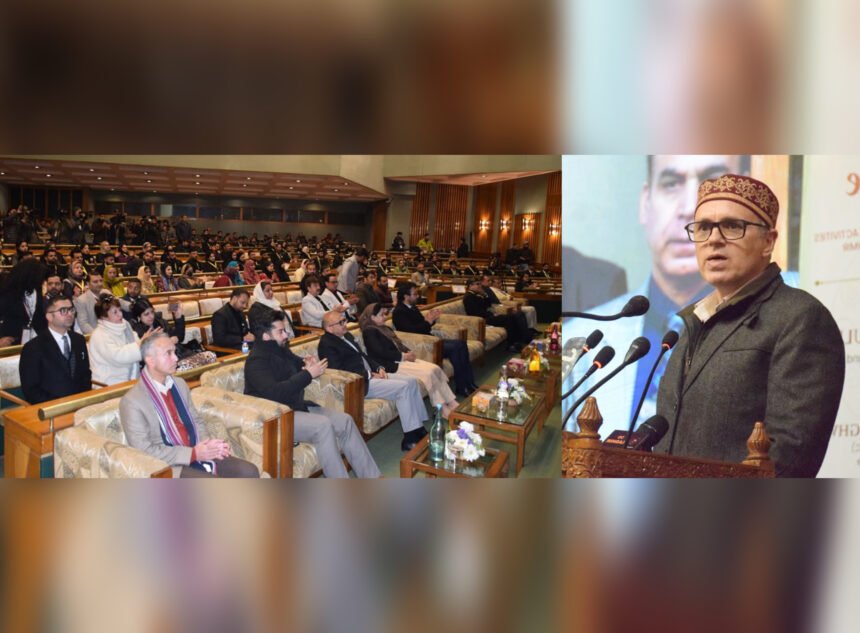
Speaking at the Regional Workshop on Tele-Law organized by the Ministry of Law & Justice at the Sher-i-Kashmir International Convention Centre (SKICC) in Srinagar, the Chief Minister expressed hope that the scheme would be strengthened through joint efforts with the Government of India and the Ministry of Justice.
“I hope that after this workshop, together with the Government of India and the Ministry of Justice, we will see how this scheme can be strengthened and expanded further. We will connect more lawyers pro bono so that everyone gets justice at the right time and in the right place,” he said.
The workshop was held under the Tele-Law initiative of the Designing Innovative Solutions for Holistic Access to Justice (DISHA) scheme, a Central Sector program implemented by the Department of Justice, Ministry of Law and Justice. The event was also addressed by Union Minister of State (independent charge) for Law and Justice Arjun Ram Meghwal, Chief Justice of the High Court of Jammu & Kashmir and Ladakh Justice Arun Palli, Secretary Law & Justice Government of India Niraj Verma, and other senior officials and stakeholders.
Highlighting the significance of Tele-Law, the Chief Minister said the initiative helps resolve disputes before they escalate to litigation. “Only those cases should reach courts where judicial hearing is necessary. Tele-Law educates people about their rights, explains the law, and promotes mediation. Resolving problems early reduces pressure on courts,” he said.
He further noted that while urban populations may have easier access to legal services, residents of remote areas often remain unaware of their rights. “For those living in rural and far-flung areas, reaching a lawyer is not easy. Tele-Law bridges this gap through technology,” he added.
The Chief Minister stressed that technology-enabled legal services ensure affordable, efficient, and timely access to justice, particularly for citizens in underserved regions of Jammu and Kashmir. He underscored that under the Constitution, every citizen has the right to justice, adding, “Justice delayed is justice denied. If it takes more time to get justice, it is equivalent to not getting it.”
Omar Abdullah also highlighted the challenges posed by rising case backlogs and court pendency nationwide, noting that reducing delays requires a multi-pronged approach: disposing of incoming cases promptly, reducing pending cases, and preventing unnecessary new cases from reaching courts.
The Chief Minister said the Tele-Law scheme in J&K has expanded significantly. “Initially there were only two districts; now 20 districts are covered, more than 4,000 panchayats are included, and over 7.5 lakh legal advices have been provided,” he informed. He stressed, however, that success should be measured by the scheme’s reach and impact relative to the population.
He emphasised learning from best practices in other states and implementing them locally to benefit more people. Omar Abdullah also appreciated the role of Common Service Centres (CSCs) in Tele-Law implementation, noting that the initiative has created renewed work opportunities for these centres.
Expressing confidence in the workshop’s outcomes, the Chief Minister said, “If we can strengthen Tele-Law through this workshop, we can reach more people and reduce pressure on the courts,” calling the workshop a successful step toward inclusive justice delivery.
The event formed part of the Department of Justice’s ongoing efforts to expand access to justice via technology-enabled legal services and to foster informed deliberations among key stakeholders. (Agency)