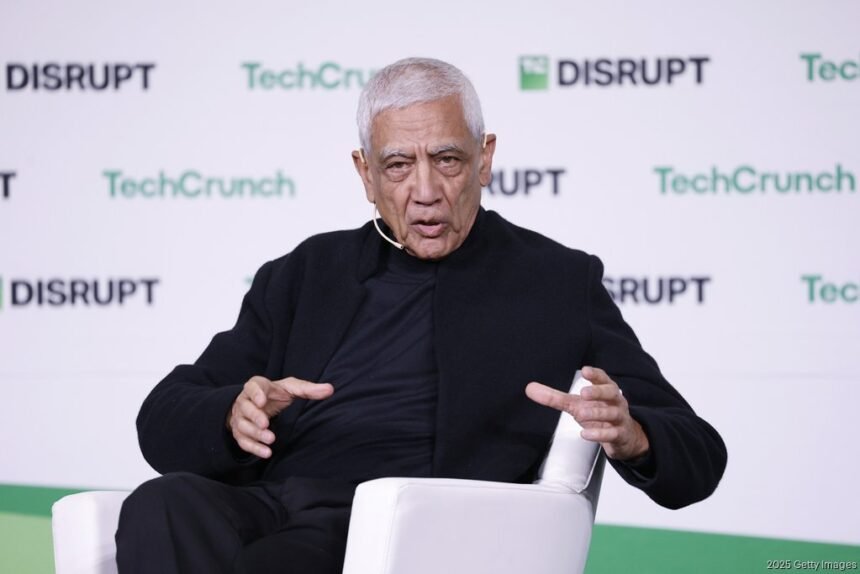
Tech billionaire and venture capitalist Vinod Khosla has said that IT services and BPO sectors could “almost completely disappear” within the next five years as artificial intelligence (AI) tools advance rapidly. In an interview ahead of the India AI Summit, Khosla warned that AI may replace most expertise-driven professions within 15 years, while also making healthcare and education far more affordable and accessible. While acknowledging the current dominance of the US and China in AI, he backed India’s push for sovereign AI models and criticised former US President Donald Trump’s immigration policies.
Edited excerpts:


Khosla, who moved to the US in the 1970s, said his entrepreneurial journey began with a dream to build a startup after graduating from IIT. Inspired by Intel co-founder Andy Grove, he went on to establish companies in Silicon Valley, including Sun Microsystems, and later founded his own venture capital firm. He said his career has focused on supporting entrepreneurs and building companies with large-scale impact.
Recalling the early days of Silicon Valley, Khosla said the startup ecosystem in the 1980s was very different, dominated by established professionals who had access to funding. As a young immigrant entrepreneur, he said he chose to ignore biases and barriers and simply focus on building his company.
On AI, Khosla described it as a technological revolution unlike previous shifts such as the internet or smartphones. While earlier platforms enabled new businesses like Google, Amazon, Airbnb and Uber, he said AI goes further by replicating human intelligence itself. Within five years, he argued, AI systems could outperform humans in most economic tasks, driving major productivity gains globally.
Looking ahead 10 to 15 years, Khosla said AI could handle nearly all forms of expertise — from accounting and medicine to chip design and architecture — while robotics would transform physical labour. He predicted that robotic labour could drastically reduce costs, potentially leading to lower inflation and even a deflationary global economy by 2035.
Addressing concerns about job losses and wealth concentration, Khosla acknowledged that fewer traditional jobs would exist in the future. However, he argued that AI could deliver essential services — including medical care, education, legal aid and entertainment — at minimal cost. Governments, he said, would need to ensure the benefits are widely distributed to maintain social stability.
For India, Khosla suggested shifting focus from traditional IT services to AI-driven products and services. He predicted that India could become a leading exporter of AI solutions over the next decade and a half, provided it invests aggressively in the sector. He also highlighted the importance of developing sovereign AI models for strategic and national security purposes, citing efforts such as Indian AI startups building localised models.
On geopolitics, Khosla warned that if AI development remains concentrated in the US and China, it could disadvantage other countries. However, he expressed confidence that India has the talent to compete, particularly as AI technology evolves beyond large language models.
Commenting on US politics and immigration, Khosla said America has historically benefited from skilled immigrants through programmes like the H1B visa system, which he believes have driven innovation-led growth. He criticised Trump’s restrictive immigration approach, arguing that limiting legal immigration could harm the US innovation economy in the long term. (Agencies)