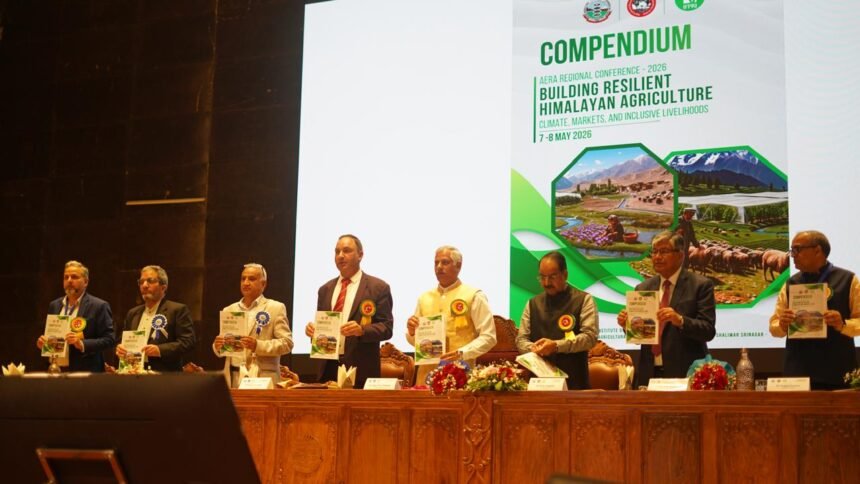
SRINAGAR, MAY 07: The Agricultural Economics Research Association (AERA) Regional Conference on “Building Resilient Himalayan Agriculture: Climate, Markets, and Inclusive Livelihoods” was inaugurated at Sher-e-Kashmir University of Agricultural Sciences and Technology Kashmir (SKUAST-K).
The two-day conference, organised by SKUAST-K’s Institute of Business & Policy Research (IBPR) in collaboration with the Agricultural Economics Research Association (AERA) and the International Food Policy Research Institute, has brought together leading experts from academia, government and development sectors to deliberate on the pressing challenges and emerging opportunities in Himalayan agriculture.


Over the next two days, the conference will host thematic technical sessions and research presentations on key issues including climate resilience, agri-market reforms, digital transformation, Farmer Producer Organisations (FPOs) and inclusive livelihood strategies.
The deliberations are expected to generate actionable policy recommendations and strategic insights aimed at strengthening the resilience, competitiveness and inclusivity of Himalayan agriculture while contributing to sustainable rural transformation.
In his address, Vice Chancellor SKUAST-K, Prof. Nazir Ahmad Ganai, reaffirmed the university’s commitment towards advancing impactful research and policy engagement tailored to the unique challenges of the Himalayan region.
He emphasized that the role of academic institutions must extend beyond knowledge generation to active participation in policy formulation and field-level implementation. He also highlighted SKUAST-K’s efforts in promoting climate-smart agriculture, sustainable resource management and farmer-centric innovations.
Guest of Honour Dr. B.N. Tripathi from SKUAST-J provided a strategic institutional perspective and stressed that transformation of Himalayan agriculture depends on strong inter-institutional collaboration and innovation ecosystems.
He elaborated on the need for efficient agri-value chains to reduce post-harvest losses, enhance value addition and improve market access for farmers in remote regions. He further emphasized the role of universities and research institutions in technology dissemination, skill development and agri-entrepreneurship.
Prof. Farhet A. Shaheen, Organizing Secretary and Head, IBPR, highlighted that climate variability, declining resource efficiency and weak market integration continue to affect the economic viability of farming in the region.
He advocated a transition from subsistence-oriented systems to resilient and market-responsive agricultural models driven by innovation, institutional reforms and value chain strengthening. He also stressed the need to empower smallholders, women farmers and rural youth through capacity building and entrepreneurial opportunities.
Delivering the keynote address, Prof. Vijay Paul Sharma, Chairman CACP, presented a detailed analysis of agricultural pricing policies in the context of climate risks and market uncertainties. He emphasized the need for dynamic and adaptive pricing mechanisms that take into account regional disparities, production risks and cost variations.