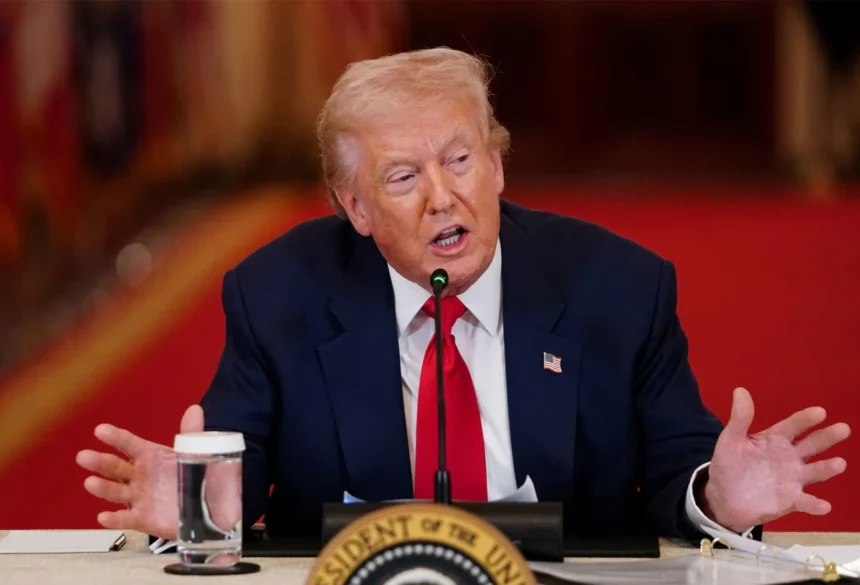
US President Donald Trump’s overt threat to Iran on Easter Sunday has triggered speculation about whether he could be removed from office under the 25th Amendment.
US President Donald Trump’s recent remarks directed at Iran, which included explicit language and a religious reference, have drawn widespread scrutiny and criticism.


In a post on Truth Social, Trump used profane language while issuing a warning to Iran, suggesting that a major action could take place on Tuesday. The post, which also included a religious phrase, has intensified backlash and sparked renewed calls for his impeachment, with critics expressing concern over the tone and implications of his statement.
Can Donald Trump be removed under the 25th Amendment? 5 things to know
1. Surge in speculation and prediction markets
There has been a noticeable rise in trading activity on Kalshi, a regulated prediction platform, where users are betting on whether the 25th Amendment could be invoked.
A contract titled “Will the 25th Amendment be used during Trump’s presidency?” has seen the probability of a “Yes” outcome climb from about 28.6% to 35.1% in recent weeks—its second-highest level since the start of Trump’s second term. The figure was around 15% in January 2025. Analysts link this rise to recent controversies, including Trump’s statements on Iran.
2. What triggered the latest concerns?
Trump’s social media posts and public remarks regarding Iran—including threats involving key infrastructure—have raised alarm among critics.
He reportedly set a deadline for Iran related to access through the Strait of Hormuz, warning of potential military action despite describing ongoing discussions as “productive.”
3. Regional escalation adds pressure
The situation is further complicated by military actions involving Israel, which has reportedly carried out strikes on Iranian energy infrastructure, including the South Pars gas field and facilities in Tehran.
Such developments have heightened fears of a broader conflict and intensified scrutiny of U.S. leadership decisions.
4. Calls to invoke the 25th Amendment
Trump’s rhetoric has prompted some lawmakers and critics to suggest that his Cabinet consider invoking the 25th Amendment, which allows for a president to be declared unfit for office.
Among them, Chris Murphy publicly criticized Trump’s actions, urging serious consideration of constitutional options and warning about potential civilian casualties and long-term consequences.
5. How realistic is removal?
Invoking the 25th Amendment—especially Section 4—is extremely difficult. It would require:
- The Vice President and a majority of the Cabinet to declare the president unfit
- Potential approval by a two-thirds majority in Congress if the president contests the decision
Historically, this mechanism has never been used to remove a sitting president against their will, making it a highly unlikely outcome despite rising political pressure.
Iran calls for 25th Amendment
Iranian diplomatic missions have also weighed in on the controversy. The Iranian Embassy in South Africa, along with other Iranian embassies worldwide, echoed criticism of US President Donald Trump’s remarks and publicly urged consideration of the 25th Amendment.
In response to Trump’s statements, the embassy posted: “Seriously think about the 25th Amendment, Section 4,” aligning with similar calls made by critics and lawmakers.
What is the 25th Amendment?
The Twenty-fifth Amendment to the United States Constitution outlines the procedures for presidential succession and provides a mechanism to transfer power if a president is unable to carry out their duties.
It allows for the replacement of a president in cases of death, resignation, or incapacity, and also includes provisions to declare a sitting president unfit for office.
Although invoking it to remove a president against their will is extremely rare—and has only been used temporarily and voluntarily in the past—it remains central to ongoing discussions about its potential application in situations involving concerns over a president’s fitness for office.
What is Section 4? All we know as it has never been enacted
Section 4 of the Twenty-fifth Amendment to the United States Constitution allows the Vice President, together with a majority of the Cabinet, to declare that the President is unable to carry out the duties of the office. In such a case, presidential powers are transferred to the Vice President, who serves as Acting President.
This provision is specifically designed for situations where a President is unwilling or unable to acknowledge their own incapacity.
If the President contests this declaration, Congress must decide the outcome. A two-thirds majority vote in both houses is required to keep the Vice President in charge; otherwise, the President regains authority.
Notably, Section 4—which provides for the involuntary transfer of power—has never been used. It is this provision that critics of US President Donald Trump are currently referencing, arguing that his recent statements and actions warrant consideration under this constitutional mechanism.
Calls for Section 4 invocation rise
Calls to invoke Section 4 of the Twenty-fifth Amendment to the United States Constitution have intensified, with several lawmakers publicly voicing concern over US President Donald Trump’s recent actions and statements.
In a post on X, Yassamin Ansari sharply criticized the president, arguing that the 25th Amendment exists for situations involving serious concerns about a leader’s fitness for office.
Earlier the same day, Ansari also questioned reported U.S.-Israeli airstrikes targeting Sharif University of Technology in Tehran, raising concerns about civilian safety and the rationale behind such actions.
Other Democratic lawmakers echoed these sentiments. Melanie Stansbury called for action by Congress and the Cabinet, publicly supporting the idea of invoking the 25th Amendment.
At the same time, some Republicans and former allies of Trump have also expressed unease, urging officials to consider constitutional measures. These concerns have been amplified by reports of internal disagreements within the administration, including remarks by Trump suggesting that Vice President J. D. Vance was less supportive of potential military action against Iran.
Trump’s health sparks speculation
There has been growing public speculation about the health of US President Donald Trump. While rumors circulating online have included claims of a medical emergency, hospitalization, or even death, these reports remain unverified.
The White House has firmly denied such claims, stating that the President has been “working nonstop” in the Oval Office.
Despite these official assurances, the speculation continues to circulate across social media and public discourse.
Health concerns and past impeachment history
Concerns about the health of US President Donald Trump intensified following a White House press conference on April 4, after viral videos—later debunked—claimed he had been rushed to Walter Reed National Military Medical Center.
Speculation has also focused on visible hand bruising—attributed by officials to routine causes such as handshakes or medication—as well as unverified claims about mobility issues and occasional verbal misstatements, including confusion between Greenland and Iceland.
Separately, Trump remains the only U.S. president to have been impeached twice during a single term. In 2019, he was impeached over allegations of abuse of power and obstruction of Congress linked to a phone call with Ukrainian President Volodymyr Zelenskyy.
In 2021, he was impeached again on a charge of incitement of insurrection following the January 6 United States Capitol attack. On both occasions, the Senate acquitted him, as the required two-thirds majority for conviction was not reached. (Agency)