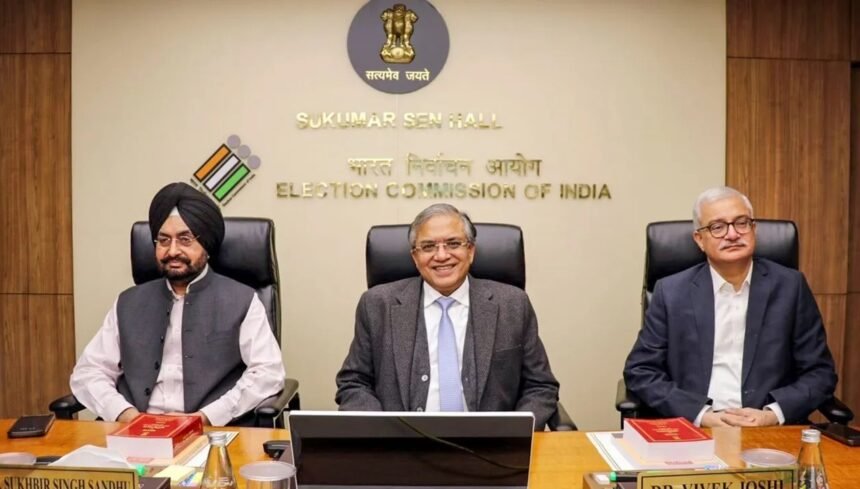
Jammu/New Delhi, March 15, 2026: The Election Commission of India (ECI) on Sunday announced the schedule for the upcoming Legislative Assembly elections in five states and Union Territories — Assam, Tamil Nadu, West Bengal, Kerala and Puducherry — with polling set to begin on April 9 and counting of votes scheduled for May 4.
As per the schedule released by the Commission, Assam, Kerala and Puducherry will go to polls on April 9, while Tamil Nadu will vote on April 23. Elections in West Bengal will be conducted in two phases, with the first phase on April 23 and the second phase on April 29. Counting of votes for all the five assemblies will take place on May 4.


With the announcement of the election dates, the Model Code of Conduct (MCC) has come into immediate effect in the respective states and Union Territory. The Commission said elaborate arrangements, including deployment of security forces and election observers, will be made to ensure free, fair and peaceful elections.
The elections will determine the composition of legislative assemblies with varying strengths. The Assam Legislative Assembly has 126 seats, the Tamil Nadu Assembly comprises 234 seats, while the West Bengal Assembly has 294 seats. The Kerala Legislative Assembly consists of 140 seats, and the Puducherry Legislative Assembly has 30 seats.
Currently, different political parties are in power across these regions. In Assam, the government is led by the Bharatiya Janata Party under Chief Minister Himanta Biswa Sarma. In Tamil Nadu, the ruling Dravida Munnetra Kazhagam government is headed by Chief Minister M. K. Stalin.
In West Bengal, Chief Minister Mamata Banerjee of the All India Trinamool Congress will be seeking a third consecutive term in office, with the election expected to witness a keen contest between the ruling party and the Bharatiya Janata Party.
Meanwhile, Kerala is governed by the Communist Party of India (Marxist)-led Left Democratic Front under Chief Minister Pinarayi Vijayan. In the Union Territory of Puducherry, the government is headed by Chief Minister N. Rangasamy of the All India N. R. Congress with support from the Bharatiya Janata Party.
Political parties are expected to intensify campaigning in the coming weeks as the electoral battle unfolds across these five regions, with key issues likely to revolve around governance, development, employment and welfare schemes.