Asif Iqbal Naik
Jammu/New Delhi, February 1, 2026:


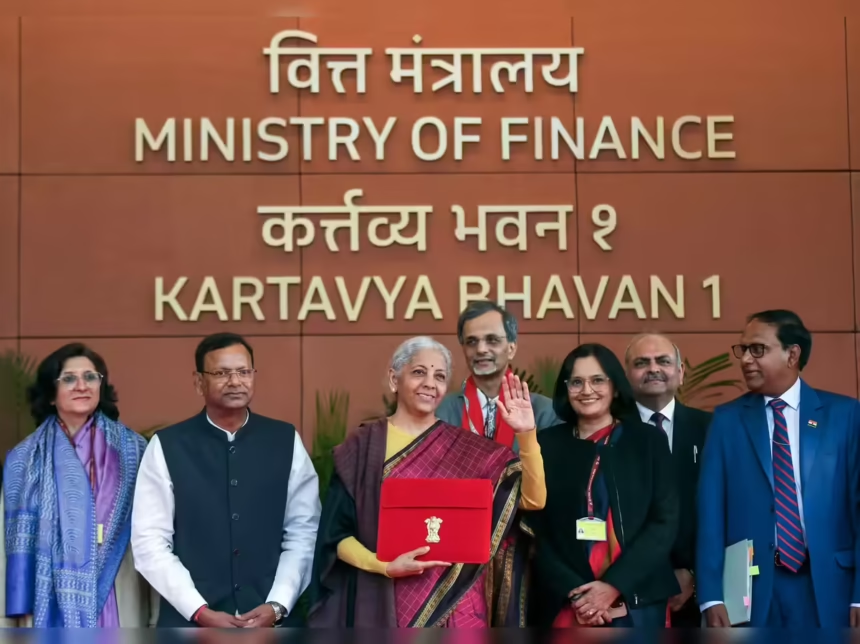
The Union Budget 2026–27 builds on last year’s framework of growth-led public spending, while stepping up capital investment, deepening manufacturing reforms and continuing fiscal consolidation.
One of the most visible changes is in infrastructure spending. Capital expenditure has been raised to ₹12.2 lakh crore in 2026–27, compared to ₹11.2 lakh crore in Budget 2025–26, underlining the government’s intent to keep infrastructure at the centre of economic expansion. Alongside this, a new Infrastructure Risk Guarantee Fund has been announced this year to encourage private participation in large projects — a mechanism not present in last year’s Budget
On fiscal management, the government has tightened its consolidation path. While the fiscal deficit for 2025–26 stood at 4.4 per cent of GDP, the Budget for 2026–27 pegs it lower at 4.3 per cent, signalling continued commitment to debt reduction. The debt-to-GDP ratio is also projected to decline further in 2026–27, helping free resources for priority spending
Total expenditure has risen from last year’s levels to ₹53.5 lakh crore in 2026–27, with net tax receipts estimated at ₹28.7 lakh crore, reflecting higher revenue expectations driven by economic growth
While Budget 2025–26 focused largely on sustaining post-pandemic recovery and public capex, this year’s Budget places a much stronger emphasis on manufacturing depth and strategic sectors. New flagship initiatives such as Biopharma SHAKTI with an outlay of ₹10,000 crore, India Semiconductor Mission 2.0, expanded electronics incentives, rare earth corridors and chemical parks mark a shift from broad-based support last year to targeted industrial scale-up in 2026–27
Support for MSMEs has also been sharpened. Compared to last year’s liquidity-focused measures, the current Budget introduces a ₹10,000 crore SME Growth Fund, additional equity for micro enterprises, mandatory TReDS usage by CPSEs and professional assistance through “Corporate Mitras” — signalling a move from survival support to building “Champion MSMEs”
In transport and urban development, 2026–27 goes beyond last year’s allocations by announcing seven High-Speed Rail corridors, new Dedicated Freight Corridors, 20 National Waterways and City Economic Regions for Tier-II and Tier-III cities with ₹5,000 crore per region over five years — a sharper focus on regional growth engines compared to 2025–26
On employment and skills, last year’s emphasis on skilling continues, but this Budget expands the scope with a High-Powered Education to Employment Committee, large-scale creation of allied health professionals and caregivers, AVGC talent development, tourism skilling and the launch of a full-fledged Khelo India Mission for sports ecosystem growth
For taxpayers, a major structural shift comes in 2026–27 with confirmation that the new Income Tax Act, 2025 will take effect from April 1, 2026, bringing simplified forms, staggered return filing, lower TCS on foreign travel, education and medical expenses, and several compliance relaxations — reforms that were not operational in last year’s Budget
In summary, while Budget 2025–26 focused on sustaining recovery through public investment, Budget 2026–27 marks a transition towards deeper manufacturing capability, targeted job creation, regional growth and tighter fiscal discipline, with higher capex and a lower deficit forming the backbone of this year’s economic strategy.