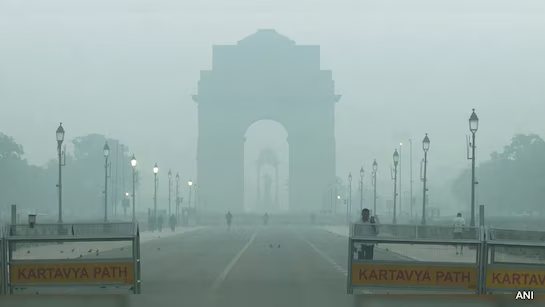
Air quality in the national capital deteriorated sharply on Tuesday morning as thick smog enveloped Delhi, severely reducing visibility and impacting daily life. The Air Quality Index (AQI) was recorded at a hazardous level, soaring to 413 at around 8 am.
According to the Central Pollution Control Board (CPCB), air quality touched the ‘severe’ category in several parts of the National Capital Region (NCR), with multiple areas continuing to report alarmingly high pollution levels.


In response to the worsening situation, the Commission for Air Quality Management (CAQM) invoked all actions under GRAP Stage-IV across Delhi-NCR.
Several pollution hotspots recorded extremely poor air quality, including Anand Vihar with an AQI of 466, Ashok Vihar at 444, and Chandni Chowk at 425, all falling under the ‘severe’ category. Authorities have advised residents to limit outdoor activities and follow health advisories amid the hazardous conditions.
India Gate, Kartavya Path and Rashtrapati Bhavan were shrouded in toxic smog on Tuesday, with the Air Quality Index (AQI) in the area recorded at 384, falling under the ‘very poor’ category.
As air quality continued to deteriorate, GRAP Stage-IV was enforced across the national capital to curb extreme pollution levels. As part of emergency measures, truck-mounted water sprinklers were deployed in several areas to suppress dust and pollutants.
According to AQI classification, levels between 0–50 are considered ‘good’, 51–100 ‘satisfactory’, 101–200 ‘moderate’, 201–300 ‘poor’, 301–400 ‘very poor’, and 401–500 ‘severe’.
Meanwhile, the Delhi government has taken a series of measures to tackle rising pollution levels and ensure a cleaner environment. Delhi Chief Minister Rekha Gupta reiterated the government’s zero-tolerance policy against all sources of pollution.
A high-level review meeting was held on Monday at the Delhi Secretariat to assess pollution control measures and take effective decisions. Key steps include strict enforcement of Pollution Under Control (PUC) norms with no waiver of challans, exploring pooled and shared electric bus services across Delhi-NCR, issuing fresh guidelines for e-rickshaws, and rationalising Delhi Transport Corporation (DTC) bus routes.