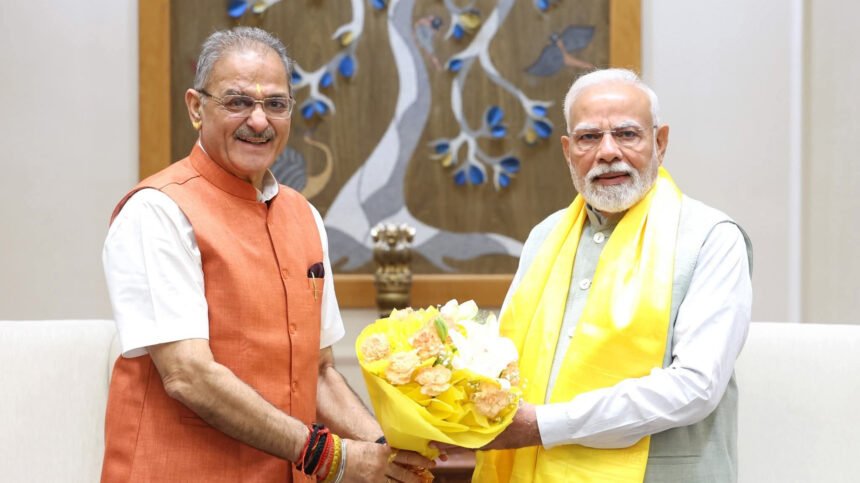
In a remarkable political journey spanning several decades, senior Bharatiya Janata Party (BJP) leader Kavinder Gupta has reached yet another milestone after being appointed as the Governor of Himachal Pradesh. His elevation to the constitutional post reflects a long career marked by grassroots activism, legislative leadership, and administrative experience across multiple levels of governance.
Born on December 2, 1959, in Jammu, Gupta’s political journey began at a young age when he joined the Rashtriya Swayamsevak Sangh (RSS) at just 13. His early exposure to organizational work and ideological training shaped his political outlook and laid the foundation for his entry into mainstream politics. During the period of The Emergency in India, Gupta spent nearly 13 months in jail, an episode that strengthened his reputation as a committed activist within the nationalist political ecosystem.


Rise Through Local Politics
Gupta’s political prominence began at the municipal level in Jammu. He created history by serving three consecutive terms as Mayor of Jammu from 2005 to 2010, becoming one of the longest-serving mayors of the city. His tenure was marked by a focus on urban infrastructure, civic administration, and municipal reforms, which helped him gain wide recognition in regional politics.
Alongside his municipal role, Gupta also strengthened the organizational base of the Bharatiya Janata Party in the region. He served as General Secretary of the BJP’s Jammu and Kashmir unit and earlier led the Bharatiya Janata Yuva Morcha in the state for two consecutive terms between 1993 and 1998.
Entry into Legislative Politics
Gupta made his electoral debut in the 2014 Jammu and Kashmir Assembly elections, contesting from the Gandhi Nagar Assembly constituency. He defeated senior Congress leader Raman Bhalla, marking the beginning of his legislative career.
Following his victory, Gupta was unanimously elected Speaker of the Jammu and Kashmir Legislative Assembly in 2015, becoming the first BJP leader to hold the position. His tenure as Speaker was seen as significant as it came during a politically sensitive period in Jammu and Kashmir’s coalition politics.
Deputy Chief Minister of Jammu and Kashmir
In April 2018, Gupta was appointed Deputy Chief Minister of Jammu and Kashmir in the coalition government led by Mehbooba Mufti. However, his tenure lasted only 51 days, ending when the BJP withdrew support from the coalition government in June 2018.
Despite the brief tenure, Gupta remained an influential political figure within the BJP and continued to play an important organizational and advisory role in the party.
Role in National Governance
In July 2025, the President of India appointed Gupta as the Lieutenant Governor of Ladakh, making him one of the few politicians from Jammu and Kashmir to hold such a high constitutional office. His appointment was viewed as recognition of his long political experience and administrative background.
After serving in Ladakh, Gupta was later elevated to the post of Governor of Himachal Pradesh in 2026, marking another significant step in his public service career.
A Political Journey Built from the Ground Up
The rise of Kavinder Gupta is often described as a classic grassroots-to-governor story. Beginning as a young activist associated with ideological organizations, he climbed the political ladder through municipal governance, legislative leadership, executive administration, and finally constitutional office.
From being a swayamsevak in Jammu to becoming a mayor, MLA, Speaker, Deputy Chief Minister, Lieutenant Governor, and now Governor of Himachal Pradesh, Gupta’s political trajectory reflects decades of persistence and organizational commitment.
Kavinder Gupta’s appointment as Governor of Himachal Pradesh symbolizes not just personal success but also the growing prominence of leaders emerging from the political landscape of Jammu and Kashmir. His journey underscores how sustained grassroots engagement, organizational loyalty, and administrative experience can eventually lead to the highest constitutional responsibilities in the country.