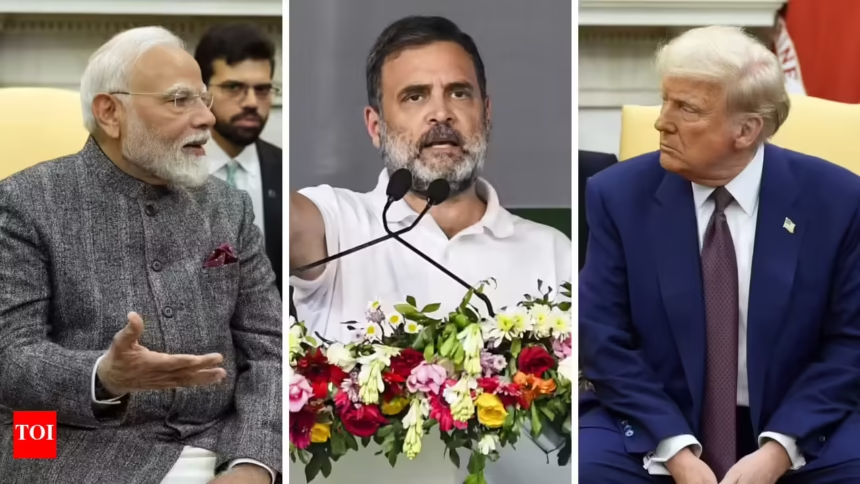
New Delhi, Feb 21: Leader of Opposition in the Lok Sabha Rahul Gandhi on Friday intensified his criticism of Prime Minister Narendra Modi following a ruling by the Supreme Court of the United States that struck down global tariffs imposed under the administration of former US President Donald Trump.
Reacting to the verdict, Gandhi took to X to reiterate his allegations regarding the India–US interim trade agreement. He accused the Prime Minister of being “compromised” and claimed that the recent court decision had exposed what he described as a flawed approach to negotiations.
“The PM is compromised. His betrayal now stands exposed. He can’t renegotiate. He will surrender again,” Gandhi wrote on the social media platform.
US Supreme Court Ruling
The US Supreme Court, in a 6–3 decision, ruled that the Trump administration had exceeded its legal authority by invoking the International Emergency Economic Powers Act (IEEPA) of 1977 to impose sweeping import tariffs. The court held that the law did not grant the executive branch unchecked powers to levy broad-based global tariffs under the pretext of a national emergency.
Calling the verdict a “terrible decision,” Trump announced plans to sign an executive order introducing a 10 percent global tariff under Section 122 of the Trade Act of 1974. The provision allows the US President to impose a temporary import surcharge of up to 15 percent for 150 days in order to address balance-of-payments concerns.
Opposition Questions India’s Trade Strategy
Earlier in the day, Priyanka Chaturvedi of Shiv Sena (UBT) also raised questions about India’s approach to the interim trade arrangement with the United States. In a post on X, she asked why India chose to finalise the deal without waiting for the US Supreme Court’s ruling.
Chaturvedi pointed out that after the court’s intervention, US tariffs on trade now stand at 10 percent, while imports from the United States to India reportedly continue at zero percent duty under the agreement. She praised Brazil for maintaining what she termed its “trade sovereignty” despite facing some of the highest tariff barriers.
“Wonder why India rushed into a deal, giving up on energy purchase decisions, giving up on farmers’ interests, rather than waiting for the US Supreme Court verdict? The trade is at 10% tariff now after the court intervention, but again, US imports to India at 0%. Well done Brazil for standing tall despite being amongst the highest tariffed nations, the country did not buckle and trade with its sovereignty. The US court decision is a vindication,” Chaturvedi said.
Debate Over Russian Oil Purchases
In another post, Chaturvedi referred to reports suggesting that countries such as China continue to purchase Russian oil despite global tariff pressures. She criticised the government’s position on energy procurement, arguing that India may have limited its leverage under the interim trade framework.
“After the US Court intervention, China like the rest of the world is at 10% tariff but hasn’t signed up its rights to purchasing Russian oil, so it’s lapping up the cheap oil with no consequences. While India, too, will be at 10% tariff but no leverage to buy the oil because we signed that away for a ‘historic 18% tariff’. The genius of India’s Trade Minister!” she said.
Political Fallout
The developments have triggered a fresh political debate over India’s trade diplomacy and its strategic positioning amid shifting global economic policies. While the government has yet to issue a detailed response to the opposition’s criticism, officials have maintained that trade negotiations are guided by long-term national interest and broader geopolitical considerations.
The US Supreme Court’s decision is expected to have significant implications for global trade dynamics, particularly for countries that had been affected by tariff measures introduced during the Trump administration. In India, however, the ruling has quickly become a point of political contention, with opposition leaders questioning the timing and terms of the interim trade agreement.