A day after the Mexican army killed the country’s most powerful drug lord, the picturesque town where the operation unfolded reflected a stark contrast.
Tourist shops in Tapalpa reopened on Monday and workers resumed their routines. Yet gunshots echoed through parts of the town, and a man’s body lay in the street beside a bullet-riddled vehicle.

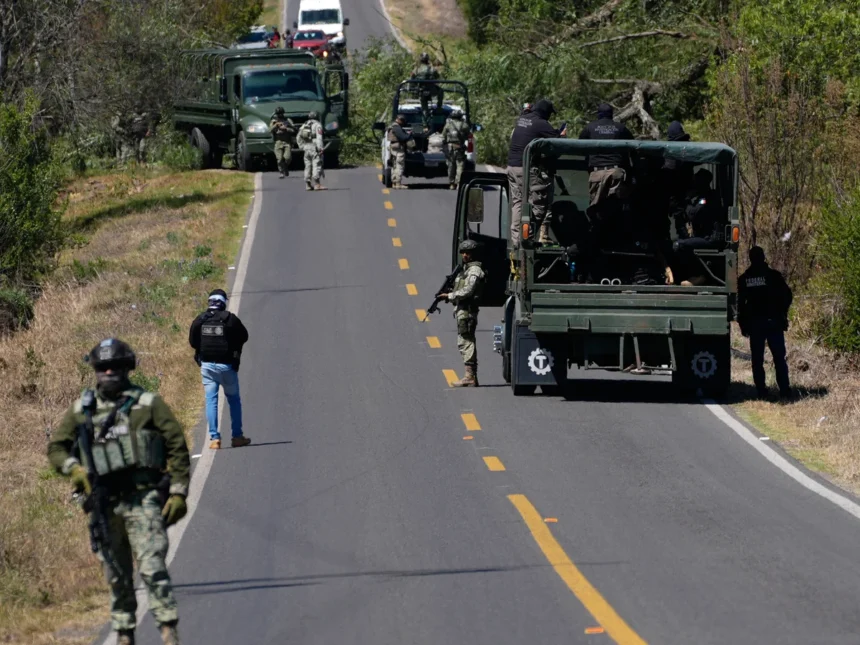
Heavily armed Mexican security forces continued operations against cartel gunmen following the killing, which triggered a surge of violence and heightened tensions nationwide. Cartel fighters maintained roadblocks as smoke rose from the outskirts of Tapalpa in Jalisco state.
Authorities said more than 70 people died during the attempt to capture Nemesio Oseguera Cervantes, known as “El Mencho,” and in the violence that followed. He led the Jalisco New Generation Cartel, one of Mexico’s most powerful criminal organisations.
The death toll included members of the security forces, suspected cartel fighters and others, though officials provided few details and the circumstances of many deaths remain unclear.
Oseguera Cervantes headed one of Mexico’s fastest-growing criminal networks, accused of trafficking fentanyl, methamphetamine and cocaine into the United States and carrying out bold attacks against Mexican officials. Following his death, the cartel unleashed widespread violence, erecting more than 250 roadblocks across 20 states and torching vehicles.
Mexican Defence Secretary General Ricardo Trevilla said authorities tracked one of Oseguera’s romantic partners to his hideout in Tapalpa. During the operation, the cartel leader and two bodyguards fled into a wooded area, where they were seriously wounded in a firefight. They were taken into custody but died while being transported to Mexico City.
In a separate operation in Jalisco, soldiers killed another senior cartel figure accused of coordinating retaliatory attacks and allegedly offering over US$1,000 for each soldier killed.
Security Secretary Omar García Harfuch said 25 members of the Mexican National Guard were killed in six separate attacks. Around 30 suspected criminals were killed in Jalisco and four more in neighbouring Michoacán. A prison guard and a state prosecutor’s office agent were also among the dead.
The White House confirmed that the United States provided intelligence support for the operation and praised Mexico’s military for eliminating one of the most wanted criminals in both countries.
Mexican officials hope the death of one of the world’s largest fentanyl traffickers will ease pressure from the Trump administration, which has urged stronger action against cartels. However, many citizens remain anxious about possible retaliation from the powerful criminal group.
As concerns over further violence grew, several states cancelled school on Monday, and local and foreign authorities advised residents to remain indoors.
In Guadalajara, the state capital, traffic was lighter than usual at the start of the workweek, though conditions had improved compared to Sunday, when much of the city was effectively shut down as residents stayed home. More than 1,000 people were stranded overnight at the city’s zoo, sleeping on buses.
US President Donald Trump has repeatedly demanded tougher action against fentanyl smuggling, warning of additional tariffs or unilateral military measures if Mexico fails to deliver results. The US State Department had offered a reward of up to US$15 million for information leading to Oseguera’s capture.
Founded around 2009, the Jalisco New Generation Cartel has been designated a foreign terrorist organisation by the Trump administration. The group is known for its aggressive tactics, including attacks on military helicopters, the use of explosives launched by drones, and the deployment of landmines. (Agency)