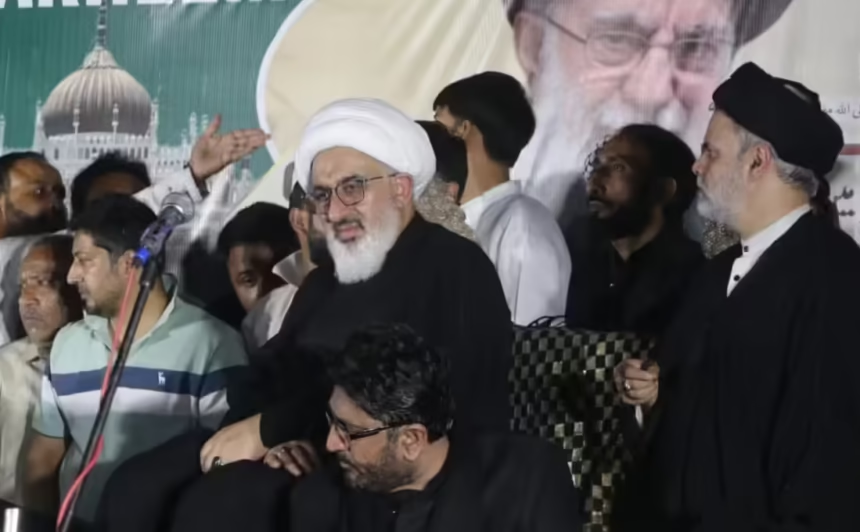
LUCKNOW: Lucknow’s Chota Imambara saw a profound display of grief and respect on Wednesday night as Abdul Majeed Hakeem Ilahi, special representative of Iran’s Supreme Leader in India, addressed a packed Majlis-e-Tarheem. While the gathering reflected mourning, the core of Ilahi’s speech highlighted Ayatollah Ali Hosseini Khamenei’s deep and lasting affection for India and its people, a sentiment that strongly resonated with those present.
Speaking in Persian and translated into Urdu by local scholar Qamar Husnain, Ilahi noted that Khamenei’s connection with India was not merely symbolic but deeply personal and rooted in intellectual appreciation.
He recalled how the Supreme Leader closely followed Indian scholarship, read works by Indian authors, and remained well-versed in the country’s intellectual traditions. “He knew Indian scholars by name and often referred to their work,” Ilahi said, highlighting the depth of Khamenei’s engagement.
Ilahi admitted that for years he had wondered why Khamenei held such affection for India. That question, he explained, only became clear after the leader’s passing. “I now understand why he loved India so much,” he told the audience, as a hush fell over the Imambara.
He also pointed to the widespread mourning across the country, which transcended religious boundaries.
“I have seen it with my own eyes,” Ilahi said. “Shia, Sunni, Hindu, Sikh, Christian—grief was not confined to any single community. People from all backgrounds expressed sorrow, shed tears, and showed their love.” He said this collective emotional response reflected the genuine bond between Khamenei and India.
Describing India as a land of justice, spirituality, and humanity, Ilahi added that it was natural for people here to feel connected to a leader who stood for dignity and moral values. His words visibly moved the audience, with many quietly weeping and others nodding in agreement.
After discussing Khamenei’s connection with India, Ilahi spoke about other aspects of his life, portraying him as a leader who combined authority with simplicity. Despite holding the highest office in Iran for decades, Khamenei never owned a personal house. Even his family, including his four sons, continued to live in rented accommodations, a revelation that drew murmurs of surprise and admiration.
“He had authority, influence, and position, yet chose a life detached from material wealth,” Ilahi said, highlighting it as a reflection of his character.
Sharing a notable incident, Ilahi recalled that when Khamenei was warned about threats to his life and advised to move to a secure bunker with his family, he refused. Instead, he asked how protection could be ensured for millions of ordinary Iranians, particularly the poor with no shelter. “How can I save myself when my people remain unprotected?” Ilahi quoted him, emphasizing his deep sense of responsibility.
Ilahi also spoke about Khamenei’s spiritual discipline, noting that he would wake hours before dawn for prayers and remained composed even during crises. Drawing a parallel with Imam Hussain, he said both exemplified sacrifice, patience, and unwavering resolve.
As the speech concluded, the atmosphere inside Chota Imambara remained heavy with emotion. (Agencies)