Asif Iqbal Naik
Jammu, Feb 6, 2026:
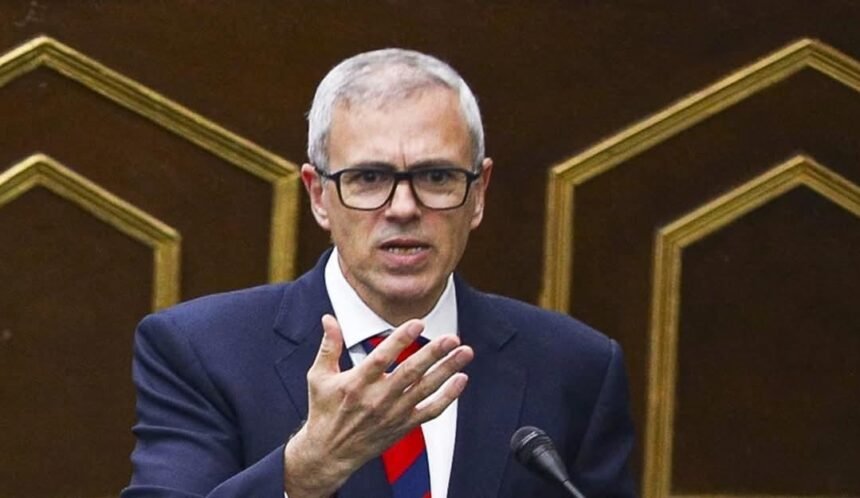
Chief Minister and Finance Minister Omar Abdullah on Thursday presented the Jammu and Kashmir Budget 2026–27, outlining an ambitious roadmap for economic revival, employment generation, infrastructure expansion and social welfare, even as the Union Territory continues to grapple with fiscal stress following terror incidents and recent floods.

Presenting his second Budget, Omar Abdullah said the document was not merely a statement of accounts but a “fiscal compass” to guide Jammu and Kashmir towards inclusive growth, resilience and sustainable prosperity. He called upon legislators to work collectively to build a stronger and more vibrant J&K.
Economy on Recovery Path
Despite setbacks caused by the Pahalgam terror attack and devastating floods in Jammu region, the Chief Minister said Jammu and Kashmir’s economy is projected to grow at around 11 percent. The Gross State Domestic Product (GSDP) is estimated to rise from ₹2.36 lakh crore in 2023–24 to ₹2.88 lakh crore in 2025–26, reflecting renewed momentum driven by reforms and capital investments.
However, Omar Abdullah acknowledged persistent fiscal stress, noting that own revenues cover only about 25 percent of budgetary needs, while salaries, pensions and debt servicing account for nearly 60 percent of expenditure. To address this, the government is pursuing austerity measures, power sector reforms, enhanced GST enforcement, and improved debt management.
He said tax and non-tax revenues stood at over ₹15,200 crore by December 2025, with sustained efforts underway to exceed last year’s collections by March-end.
Big Push Through Central Assistance
A major highlight of the Budget was Jammu and Kashmir’s inclusion under the Special Assistance to States for Capital Investment (SASCI) scheme, providing 50-year interest-free loans for infrastructure projects. Under this framework, J&K secured multiple tranches of ₹1,431 crore each for capital works, disaster mitigation and restoration following floods.
Mining, land governance and urban planning reforms under SASCI have also earned incentives, while large-scale digitisation of land records, revenue courts and cadastral maps is improving transparency and ease of doing business.
Employment and Governance Reforms
The Chief Minister announced that 7,650 candidates were appointed to government service during 2025 through transparent, merit-based recruitment. He proposed fast-tracking recruitment for 23,800 additional posts, including gazetted, non-gazetted and Class-IV vacancies.
He also assured the House that a phased roadmap for regularisation of daily-rated and casual workers would be announced based on recommendations of a high-level committee.
Compassionate appointments were extended to 910 families, while honorariums of vocational instructors were enhanced and timely payments to ASHA and Anganwadi workers assured.
Mission Karmayogi training has onboarded over 1.25 lakh government employees, strengthening administrative capacity.
Agriculture, Dairy and Rural Economy
Agriculture and allied sectors received a capital allocation of ₹1,878 crore. Key initiatives include expansion of high-density horticulture plantations, protected cultivation, mushroom and honey production, and digital farmer services through Kisan Sathi and Kisan Khidmat Ghars.
The government announced plans to set up seven milk processing plants costing around ₹770 crore, benefiting nearly 11 lakh dairy farmers and raising milk processing capacity from 4 percent to 25 percent over the coming years.
Rural development saw a capital allocation of ₹3,456 crore, with progress under MGNREGA, PMAY housing, watershed works and the Lakhpati Didi initiative, under which over two lakh women have already achieved sustainable income levels.
Tourism Revival and Youth Focus
Despite disruptions, J&K recorded over 1.61 crore tourist visits in 2025. The government plans to develop new destinations, promote adventure and sports tourism, strengthen environmental infrastructure at Gulmarg and Sonamarg, and organise an International Film Festival in 2026–27.
A new JK Tourism Mobile App and expanded homestay policy aim to support local entrepreneurs. Tourism and Youth Affairs received ₹472 crore in capital expenditure.
Industry, MSMEs and Startups
Since 2020, over 2,200 industrial units with investments exceeding ₹15,900 crore have commenced production, generating employment for nearly 74,000 people. Jammu and Kashmir ranked 5th nationally in Ease of Doing Business.
The government announced a Self-Certification Scheme for MSMEs, revival incentives for sick units, expanded startup funding and upgraded industrial estates. The Industry and Handicrafts sector was allocated ₹461 crore.
Major Investments in Health and Education
Health and Medical Education received ₹1,866 crore in capital allocation. Over 4,000 health facilities have been developed, including 15 medical colleges and two AIIMS. AIIMS Kashmir is set to be commissioned by June 2026. New hospitals, MRI and CT scan facilities, telemedicine centres and AYUSH institutions are also planned.
Medical education will expand with 548 additional seats this year, including MBBS, PG and DNB.
School and Higher Education received ₹1,513 crore, with major thrust on NEP implementation, kindergartens, smart classrooms, PM-SHRI schools, vocational education, and solarisation of educational institutions. Several new degree colleges will become functional in 2026–27, while a policy for private universities is being finalised.
Transport, Energy and Technology
The Budget provides for induction of 200 electric buses under a green mobility initiative, strengthening JKRTC and automated vehicle testing stations. Science and Technology received ₹177 crore, including revival of biotechnology parks, expansion of solar pumps, solar villages in tribal areas, EV charging infrastructure and hybrid solar parks.
Social Security, Women and Tribal Welfare
Pension rates were enhanced, benefiting over 10 lakh beneficiaries, with annual outlay rising to ₹1,755 crore. Marriage assistance for poor girls was increased to ₹75,000, while Ladli Beti Scheme coverage expanded to nearly 1.92 lakh girl children.
Women now enjoy free travel on government buses, a first-of-its-kind initiative in the region.
For tribal welfare, ₹235 crore was allocated, covering hostels, Eklavya schools, livelihood units and infrastructure in tribal-majority villages.
Mission YUVA and Skilling Drive
Mission YUVA emerged as a flagship employment initiative, with 47,000 applications approved and over 16,500 enterprises already sanctioned bank loans worth nearly ₹800 crore. A comprehensive Skill and Entrepreneurship framework will link education, skilling and placement, supported by new ITIs, digital platforms and industry partnerships.
Commitment to Migrants and Food Security
The government is accelerating construction of transit accommodations for Kashmiri migrants, improving civic services in migrant colonies and expanding Ayushman Bharat coverage. Smart PDS will be rolled out in 2026–27, while Antyodaya families continue to receive 10 kg free ration per person.