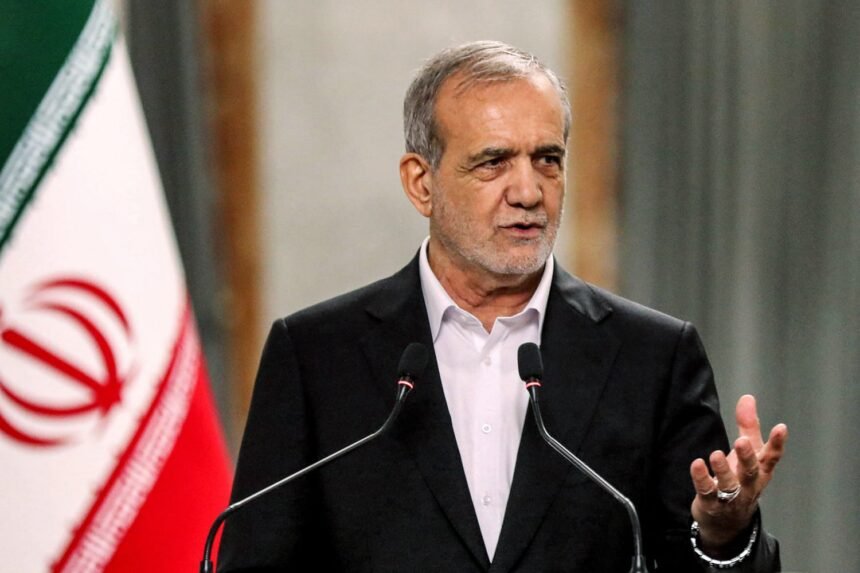
Iranian President Masoud Pezeshkian has vowed that Tehran will not yield to pressure from the United States after US President Donald Trump said he was considering limited military strikes to push Iran into a nuclear agreement.
Speaking at a ceremony honouring members of Iran’s Paralympics team on Saturday, Pezeshkian declared that the country would stand firm despite mounting tensions.
“We will not bow down in the face of any of these difficulties,” he said. “World powers are lining up to force us to bow our heads. Just as you did not bow in the face of hardship, we will not bow down now.”


His remarks come as Washington significantly increases its military footprint in the region, deploying two aircraft carriers and more than 120 aircraft to the Middle East — reportedly the largest US air buildup in the area since the 2003 Iraq invasion. The USS Gerald R. Ford is set to join the USS Abraham Lincoln carrier strike group already stationed in the Arabian Sea.
Tehran and Washington resumed indirect negotiations over Iran’s nuclear programme in Oman earlier this month, followed by a second round of talks in Switzerland. While both sides described the discussions as constructive, no breakthrough has yet been achieved.
Iranian Foreign Minister Abbas Araghchi said a diplomatic solution was within reach and that Tehran was preparing to finalise a draft proposal to send to Washington within days.
However, tensions remain high. Trump recently warned that “bad things will happen” if a meaningful deal is not reached and suggested Iran has only a limited window — “10 to 15 days, maximum” — to negotiate. He also acknowledged he was considering limited military action.
Iran, in a letter to the United Nations Security Council, warned that the US military build-up “must not be treated as mere rhetoric” and pledged to respond “decisively and proportionately” to any aggression, while insisting it does not seek war.
Public sentiment inside Tehran reflects both anxiety and resilience. Some residents expressed fears of conflict and its economic fallout, while others argued that confrontation would ultimately force Washington back to the negotiating table.
The renewed standoff follows failed nuclear talks last year, which collapsed after regional hostilities escalated into direct military exchanges involving Israel and US strikes on Iranian nuclear facilities at Fordow, Natanz and Isfahan.
With diplomacy hanging in the balance and military forces massing in the Gulf, both nations appear once again at a critical crossroads. (Agencies)