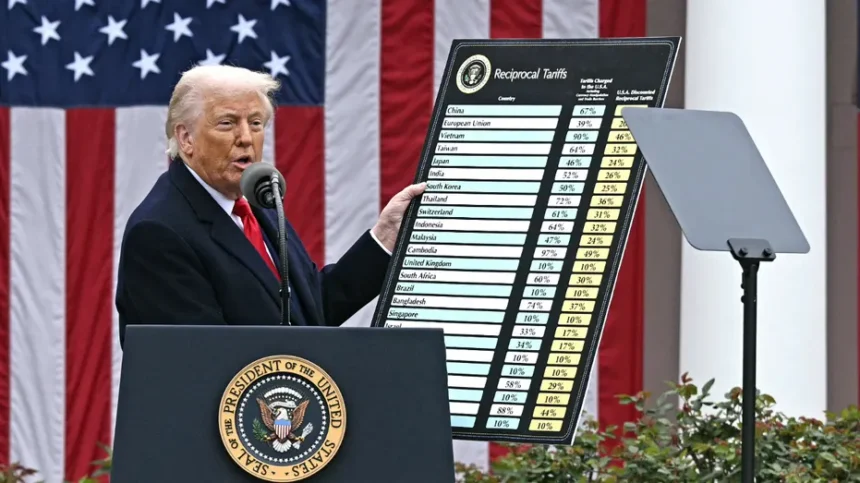
US President Donald Trump attributed what he described as “record financial performance” to his administration’s tariff policy, claiming the United States has “generated hundreds of billions of dollars” in revenue with “virtually no inflation.”

In a post on Truth Social, Trump wrote that strong financial figures had been released, saying the country had “never done better.” He said tariffs were the main reason for the performance, adding that the policy had brought in hundreds of billions of dollars, maintained low inflation, and strengthened national security.
His comments come as debates continue across the United States over trade policy, inflation trends, and the wider effects of tariffs on consumers and global markets.
Earlier on Tuesday, Trump described his tariff strategy as the foundation of what he called the “strongest and fastest economic turnaround” in US history. He said the policy had generated significant revenue for the US Treasury and helped ease inflationary pressures.
Speaking at the Detroit Economic Club after visiting Ford Motor Company’s historic River Rouge Complex, Trump said economic growth was accelerating, productivity was increasing, investment was rising, incomes were improving, and inflation had been brought under control. He also highlighted the imposition of a 25 per cent tariff on foreign automobiles, saying the move had revitalised the domestic auto industry.
Trump said US auto manufacturers were seeing more than $70 billion in new investment, much of it flowing into Detroit, which he referred to as the global centre of car manufacturing.
Defending his broader tariff approach, Trump claimed the policy had delivered major fiscal benefits, including hundreds of billions of dollars in revenue, reduced inflation, and a 27 per cent cut in the federal budget deficit over a short period.
Dismissing criticism that tariffs increase prices for consumers, Trump said predictions made by critics had not come true. He argued that tariffs were paid by foreign countries and intermediaries rather than American consumers, adding that economic experts who opposed the policy had been proven wrong. ……..(Agencies)