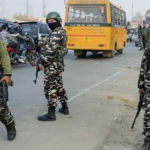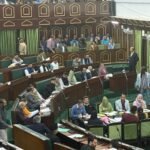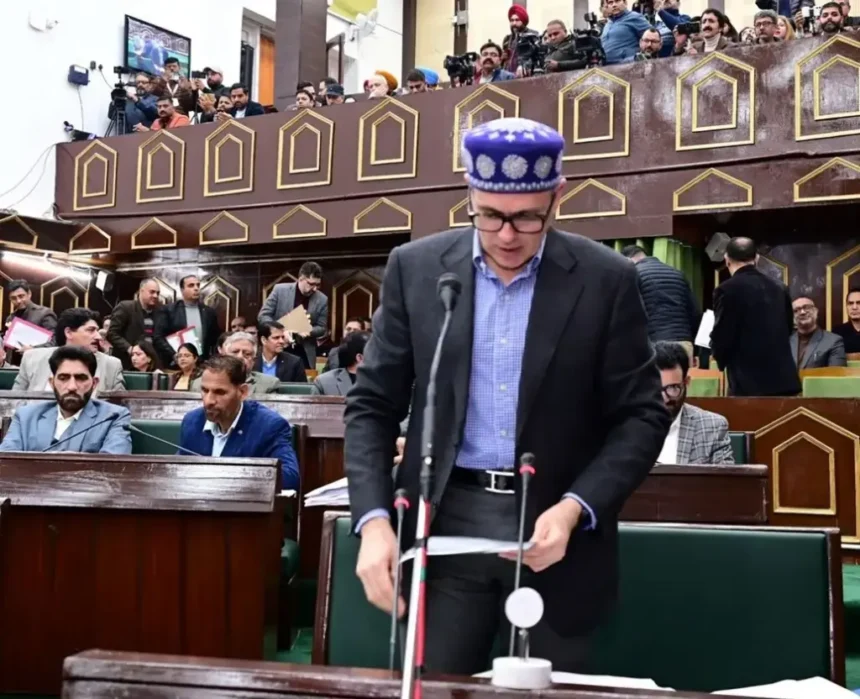
JAMMU, Feb 20: All tourist destinations that were closed in Jammu and Kashmir following the Pahalgam terror incident are likely to reopen by May this year. Additionally, nine new tourist sites will be developed across the Union Territory, with Jammu expected to receive its fair share of tourism projects, Chief Minister Omar Abdullah said in the Legislative Assembly today.
He also announced that an additional 3,000–3,500 MW of hydropower capacity will be harnessed over the next two to three years in consultation with the Centre, over and above the existing 3,000–3,500 MW already tapped. This would raise the total realised capacity to nearly 7,000 MW out of the Union Territory’s estimated 18,000 MW potential, he added.
The Chief Minister further said that two to three major housing projects will be launched in Jammu and Srinagar, with a special focus on providing affordable housing to the Economically Weaker Sections (EWS).
He also said that the anti-encroachment drive will now begin with major land grabbers, ensuring that influential and well-connected encroachers are acted against first. The process of regularising daily rated workers will also be initiated this year in a legally sound and financially sustainable manner.
On climate concerns, he stated that climate response will be prioritised by assigning the subject to a designated Government department to assess its impact and recommend mitigation and adaptation measures.
Meanwhile, Chief Minister Omar Abdullah termed the existing advertisement distribution mechanism for media houses as “vague” and lacking transparency. Emphasising that he does not believe in media censorship, he asserted that advertisements will not be used as a pressure tool in Jammu and Kashmir and that the system will be rationalised in consultation with the media fraternity.
Replying to the discussion on grants of his departments, the Chief Minister delivered a comprehensive response covering tourism revival, employment generation, fiscal management, power reforms, housing, climate adaptation, relief and rehabilitation, media policy, encroachments and administrative reforms.
Describing tourism as the backbone of the Union Territory’s economy, he said the Government conducted extensive outreach campaigns across various States to restore tourist confidence after last year’s disruptions, particularly following the Pahalgam incident. He acknowledged that many stakeholders had feared a prolonged slump in tourist inflow, but maintained that sustained outreach efforts helped revive confidence.
He said that despite nearly half of the tourist destinations being closed at one point, the Government continued its efforts to revive the sector. Hotels in Gulmarg and Sonamarg are currently witnessing significant footfall, while tourism activity in Srinagar has recovered to around 30–40 per cent, he added.
The Chief Minister noted that certain destinations such as Doodhpathri and Yusmarg had limited accessibility after the Pahalgam incident, and gondola rides were restricted to specific points. Despite these constraints, he said the sector showed resilience due to the Government’s persistent efforts to promote Jammu and Kashmir as a safe destination.
He expressed hope that all closed tourist destinations would reopen by May, following discussions with the Central Government, while acknowledging that certain constraints remain. He also announced that nine new tourist destinations will be developed under a centrally sponsored scheme, with Jammu assured its due share.
On power development, he reiterated that Jammu and Kashmir has an estimated hydropower potential of 18,000 MW, of which only 3,000–3,500 MW has been harnessed so far. In the next two to three years, another 3,000–3,500 MW is expected to be realised, raising total capacity to around 7,000 MW. Plans are also being prepared in consultation with the Government of India to tap the remaining potential over the next 10–15 years.
He clarified that there is no proposal to privatise DISCOMs and stressed the need for financial discipline and improved infrastructure under the RDSS scheme. Consumers, he said, must pay for the electricity they use, though subsidies will continue for economically weaker sections.
On employment, he said the long-pending issue of daily rated, ad-hoc and temporary workers will be addressed this year through a structured and legally vetted policy. A committee headed by the Chief Secretary has been constituted to examine the matter to ensure the policy withstands legal and financial scrutiny.
He further said that nearly 30,000 vacant posts will be filled this year in coordination with recruitment agencies, ensuring transparency and timely appointments.
Defending the Government’s fiscal management, he said there is currently no off-budget borrowing and that efforts are being made to reduce liabilities and interest burden. He described SASCI funding as a long-term, interest-free facility that will significantly boost development.
On housing, he announced that two to three major housing projects will be launched in 2026 in Jammu and Srinagar, with special provisions for Economically Weaker Sections.
Reiterating his stand on media freedom, the Chief Minister said the advertisement policy will be made transparent and rational, based on circulation and reach, after consultations with media representatives. He maintained that advertisements would never be used to influence editorial policy.
The Legislative Assembly later passed grants for multiple departments after detailed discussions, along with supplementary grants amounting to over Rs 3.52 lakh crore. (Agency)