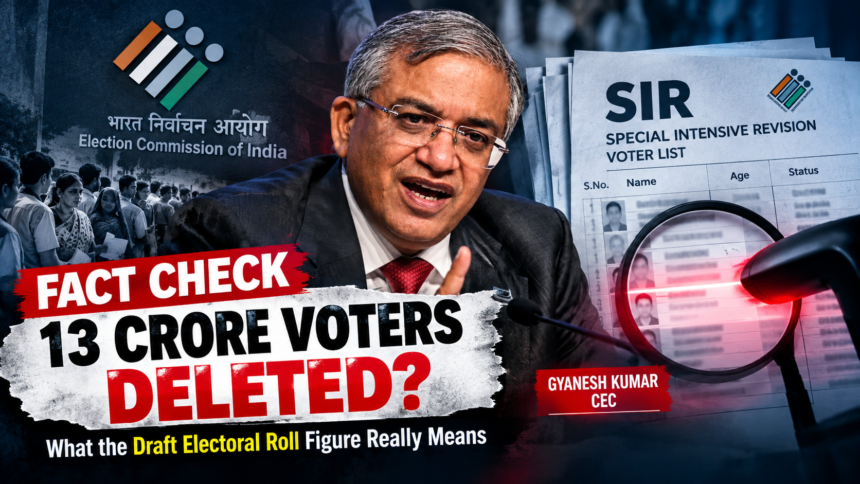
The viral “13 crore deleted voters” claim needs context. The figure cited in the electoral-roll revision refers to four different draft-stage categories — dead, absent/untraceable, permanently shifted and multiple enrolment — and does not, by itself, establish 13 crore final deletions.
News Insider 24×7 Fact Check | New Delhi
A figure of approximately 13 crore has emerged at the centre of the ongoing debate over electoral-roll revision, prompting claims on social media that 13 crore voters have been deleted from the electoral rolls.

But a closer examination of the figures presented in the electoral-roll narrative shows that the number refers to four separate categories of entries identified during the draft-stage exercise.
The categories cited are:
| Category | Entries cited |
|---|---|
| Dead | 2.8 crore |
| Absent/Untraceable | 3 crore |
| Permanently Shifted | 6.3 crore |
| Multiple Enrolment | 1 crore |
| Total | 13.1 crore |
The material refers to these categories collectively as ASDD.
The central point is that a draft-stage ASDD entry is not automatically equivalent to a final deletion from the electoral roll.
THE CLAIM
“13 crore voters have been deleted from the electoral rolls.”
WHAT THE RECORD PRESENTED HERE SHOWS
The approximately 13-crore figure represents entries placed in four different categories during the draft-stage electoral-roll exercise.
Those categories include people reported as deceased, people who were absent or could not be traced, voters identified as having permanently shifted and cases involving multiple enrolment.
Therefore, the figure should not be treated as though all 13 crore entries represent one identical category of voters who were finally removed.
WHY THE WORD “DELETED” MATTERS
The distinction between “flagged in a draft” and “finally deleted” is critical.
An electoral-roll revision involves multiple stages. The preparation of a draft roll is not necessarily the final stage of the process.
According to the material, after entries are identified during the revision, the process can involve:
- Claims by affected persons
- Objections
- Verification of records
- Notices and hearings, where applicable
- Decisions by designated electoral officers
- Preparation of the final electoral roll
An appeal mechanism under Section 24 is also identified for applicable electoral-roll decisions.
This means that the following two statements have different meanings:
“13 crore entries were identified in draft-stage ASDD categories.”
and
“13 crore voters were finally deleted.”
The first is the figure described in the material. The second cannot be established merely by citing that draft-stage figure.
THE FOUR CATEGORIES EXPLAINED
1. 2.8 Crore: Entries Categorised as Dead
The first category cited in the material consists of approximately 2.8 crore entries categorised as dead.
This category is fundamentally different from a voter who has moved to another address or someone who could not be located during verification.
2. 3 Crore: Absent or Untraceable
Approximately 3 crore entries are cited under the absent/untraceable category.
Being absent or untraceable during a verification exercise is a different circumstance from being reported deceased. The subsequent verification and electoral-roll process therefore matters when determining the final status of an entry.
3. 6.3 Crore: Permanently Shifted
The largest category cited is 6.3 crore entries identified as permanently shifted.
This category relates to voters whose registration may no longer correspond to their ordinary residence.
The material separately states that electoral registration is linked to ordinary residence and that people who permanently move need to have their electoral registration reflected at their new residence.
4. 1 Crore: Multiple Enrolment
Approximately 1 crore entries are cited under multiple enrolment.
This refers to cases where more than one enrolment is identified.
Again, this is a different category from death, permanent migration or an inability to locate a voter.
The four categories should therefore not be collapsed into one undifferentiated description of “deleted voters.”
DRAFT ROLL VS FINAL ROLL: THE KEY FACT-CHECK
A major source of confusion in the debate is the tendency to treat a draft electoral roll as the final electoral roll.
The material explicitly distinguishes between the two.
During revision, records may be flagged because information indicates that a voter is deceased, permanently shifted, absent/untraceable or involved in multiple enrolment.
Those records can then go through the prescribed claims, objections and verification process before the final roll is prepared.
Why this distinction matters
A person appearing in a draft-stage category does not, on the information presented here, automatically establish that the person has been finally removed from the electoral roll.
The final status has to be considered after the subsequent stages of the process.
WHAT HAPPENS IF A VOTER’S NAME IS MISSING?
The electoral-roll process described in the material includes field verification as well as administrative procedures.
Booth Level Officers, or BLOs, conduct house-to-house verification during enumeration.
Where a discrepancy requires further action, the process may involve notice and, where applicable, a hearing.
For eligible people seeking inclusion in the electoral roll, Form 6 remains the registration route.
The material identifies four qualifying dates for enrolment:
January 1 | April 1 | July 1 | October 1
This means the electoral-roll process includes mechanisms both for examining existing entries and for registering eligible voters who need to be added.
WHAT ABOUT FIRST-TIME AND YOUNG VOTERS?
Another claim addressed in the material is that young voters have no route to registration.
The material states that eligible citizens can qualify for enrolment on four qualifying dates and that Form 6 remains available.
It further states that approximately 2.37 crore people aged 18–28 have been added to the electoral roll since June 24, 2025.
The material calculates this at approximately 16 lakh additions per month during the period cited.
During SIR, an additional Declaration was attached to Form 6 for the exercise, according to the material. It states that this was intended to allow the required information to be provided through the same process.
FACT CHECK: “SOFTWARE DELETED THE VOTERS”
Another part of the online debate concerns the role of software in electoral-roll revision.
The material distinguishes between digital platforms used to manage electoral information and the statutory decision-making process.
It states that platforms such as ECINET are used for information management and administrative workflows, while statutory electoral officers remain responsible for the relevant electoral-roll decisions.
This distinction is important.
The presence of a digital database does not, by itself, establish that software independently made the final legal decision regarding a voter’s inclusion or exclusion.
The material specifically cautions against conflating digital voter-roll management with the operation of EVMs or the electronic alteration of votes.
EVMs AND VOTER LISTS ARE TWO DIFFERENT SYSTEMS
The electoral-roll debate has also been accompanied by claims linking digital voter databases with EVMs.
The material treats these as separate components of the election process.
According to the narrative, EVMs are standalone machines and are not connected to a network.
It also identifies several procedures preceding polling, including:
- First Level Checking
- Randomisation
- Mock polls
- Allocation procedures
- VVPAT-related verification mechanisms
The material states that EVM allocation involves two rounds of randomisation.
It further states that VVPAT provides a paper trail and that the prescribed process includes matching VVPAT slips from five randomly selected polling stations per Assembly constituency with the corresponding EVM count.
The broader distinction is therefore between:
Electoral-roll management → voter registration and roll administration
and
Polling/counting systems → EVM, VVPAT and associated election procedures
FACT CHECK: “AI PREPARED THE VOTER LIST”
The material also addresses a claim that artificial intelligence was used to prepare the voter list.
It states that the claim that AI prepared the voter list is incorrect, and that the voter-list preparation process described in the material does not use AI to decide voter inclusion or exclusion.
As with the software issue, the key distinction is between technology used for administrative functions and the formal process of electoral decision-making.
THE GOA CASE INVOLVING 97 VOTERS
The material also examines an example involving 97 voters in Goa.
According to the information presented, the issue involved inadvertent errors at the Electoral Registration Officer level, rather than an automated software decision to reject 97 voters.
The material states that the affected cases were subsequently processed.
The example is relevant because individual voter-roll discrepancies can arise at the administrative level and need to be examined on the facts of the particular case.
WHEN VOTERS MOVE: THE BELA ESTATE EXAMPLE
Another example cited in the material is Bela Estate, where the number of voters reportedly fell from 729 to one.
According to the material, the change followed demolition and resettlement, with residents no longer ordinarily residing at the old location.
It further states that around 500 affected voters submitted Form 6 to register at their new addresses.
This example highlights an important distinction: a reduction in the number of voters associated with a particular location does not, by itself, establish that those individuals have ceased to be eligible voters.
Their electoral registration may instead need to be updated to reflect their new ordinary residence.
WHAT DOES THE EVIDENCE ESTABLISH — AND WHAT DOES IT NOT?
ESTABLISHED BY THE MATERIAL
- Approximately 13.1 crore entries are cited across four draft-stage ASDD categories.
- The categories are Dead, Absent/Untraceable, Permanently Shifted and Multiple Enrolment.
- The draft-stage figure is not presented as identical to the final electoral-roll figure.
- Claims, objections and verification form part of the process described.
- Form 6 remains the route cited for eligible voter registration.
- The material states that approximately 2.37 crore people aged 18–28 were added to the electoral roll since June 24, 2025.
- The material describes EVMs as standalone machines and distinguishes them from electoral-roll databases.
- The material rejects the claim that AI was used to decide voter inclusion or exclusion.
WHAT THE 13-CRORE FIGURE ALONE DOES NOT ESTABLISH
The figure alone does not establish that 13 crore voters were finally deleted from the electoral roll.
It also does not, by itself, establish how many entries from each category ultimately remained excluded after verification, claims, objections, hearings and finalisation.
That distinction is central to interpreting the number accurately.
NEWS INSIDER 24×7 FACT-CHECK VERDICT
CLAIM: “13 CRORE VOTERS WERE DELETED.”
ASSESSMENT: MISLEADING WITHOUT CONTEXT
The approximately 13-crore figure cited in the material refers to four draft-stage ASDD categories — Dead, Absent/Untraceable, Permanently Shifted and Multiple Enrolment.
The material does not support treating the entire figure as 13 crore final deletions.
The electoral-roll process includes subsequent stages of verification, claims, objections and finalisation. Therefore, the draft-stage figure and the final number of deleted voters should not be treated as interchangeable.
For voters and readers, the crucial question is not simply “How many?” but also:
“How was the number calculated, what category does it represent, what stage of the electoral-roll process does it describe, and what happened after verification?”
That distinction is essential when assessing viral claims about voter-list revisions.
News Insider 24×7 | Fact Check
This report is based on the electoral-roll information and claims contained in the material reviewed for this fact-check. Figures and procedural descriptions have been retained as presented in the source material. The distinction between draft-stage entries and final electoral-roll outcomes is central to the assessment.