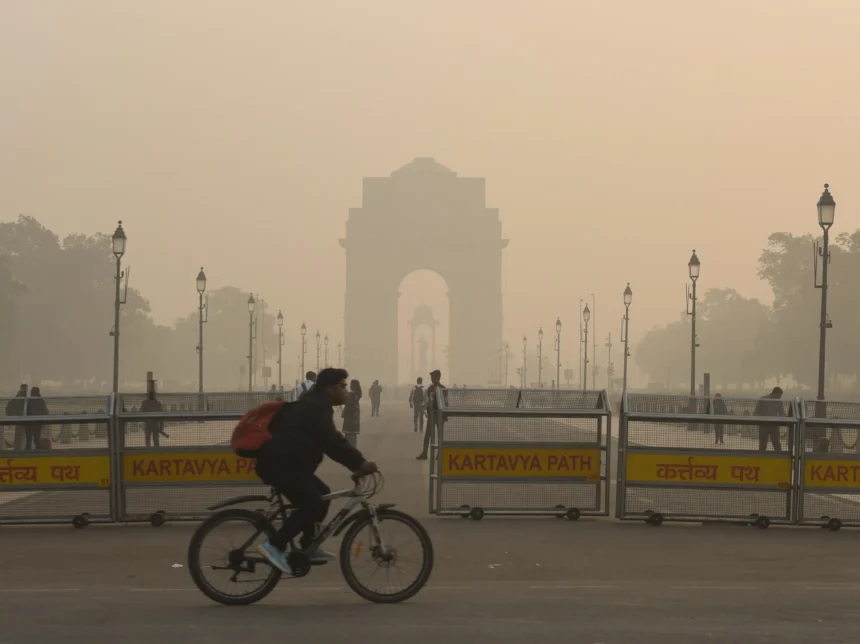
New Delhi, Jan 22: Delhi continued to grapple with ‘very poor’ air quality on Thursday morning, despite a marginal improvement in pollution levels. The Air Quality Index (AQI) was recorded at 312 around 7 am, according to data released by the Central Pollution Control Board (CPCB).

Although the AQI showed a slight improvement from 341 on Wednesday morning, pollution levels across the national capital remained firmly in the ‘very poor’ category. The prolonged deterioration in air quality continues to pose serious health risks, especially for children, the elderly, and those with respiratory illnesses.
Several parts of the city recorded high pollution levels. According to CPCB:
- Anand Vihar: 379
- Ashok Vihar: 333
- Wazirpur: 336
- Punjabi Bagh: 338
- RK Puram: 359
- Bawana: 323
- ITO: 331
- Chandni Chowk: 361
- Dwarka Sector 8: 342
All these areas fall under the ‘very poor’ AQI category.
AQI Classification: A reading of 0–50 is ‘good’, 51–100 ‘satisfactory’, 101–200 ‘moderate’, 201–300 ‘poor’, 301–400 ‘very poor’, and 401–500 ‘severe’.
Meanwhile, the India Meteorological Department (IMD) reported moderate to dense fog at several locations in Delhi. The temperature at 7 am was around 7.4°C, adding to the challenging weather conditions for residents.
In response to deteriorating air quality, the Delhi government on Wednesday decided to double parking charges at authorised sites whenever GRAP Stage III (‘Severe’, AQI 401–450) or Stage IV (‘Severe Plus’, AQI above 450) is invoked. The move is aimed at discouraging private vehicle use during periods of extreme pollution.
Parking facilities owned by the Delhi Metro Rail Corporation (DMRC) have been exempted from this charge increase.
According to a 2015 IIT Kanpur study on air pollution and greenhouse gases, vehicles contribute approximately 19.7% of PM10 and 25.1% of PM2.5 in winters, and about 6.4% of PM10 and 8.5% of PM2.5 in summers. Vehicles are also responsible for 18% of CH4 emissions, 92% of N2O emissions, and 30% of CO2 emissions in the city annually.
Delhi has a total of about 82.4 lakh registered vehicles and 677 parking facilities with approved capacity for around 1,06,037 vehicles (excluding 91 DMRC parking areas).
The government’s notification noted that the move aligns with directions from the National Green Tribunal (NGT), which instructed the administration to provide destination buses and discourage the use of private vehicles—including two-wheelers, cars, and heavy vehicles—to curb air pollution in the capital. (Agencies)