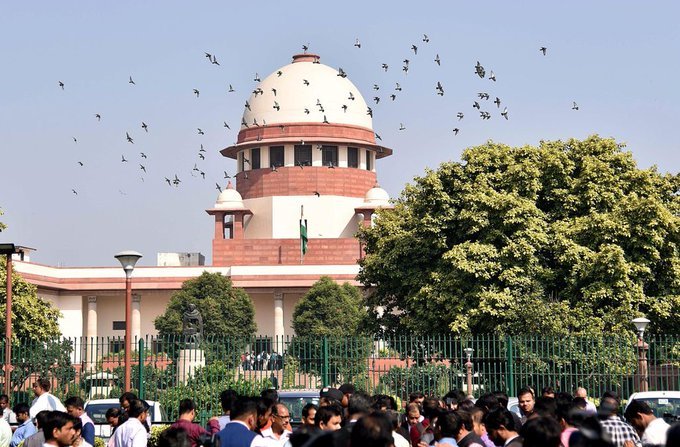
New Delhi, November 7: The Supreme Court of India has ruled that compulsory retirement of a government employee is neither punitive nor stigmatic in nature and does not imply any finding of misconduct against the employee.
A Bench of Justices Manmohan and Shree Chandrashekhar made the observation while upholding the Chhattisgarh government’s decision to compulsorily retire five out of 14 government employees under a 2017 government circular.

The court observed that compulsory retirement is based on the competent authority’s assessment that an employee’s continued service is no longer in the public interest or may affect administrative efficiency.
However, the Bench clarified that such decisions cannot be based on mere assumptions, conjecture or personal discretion. They must be supported by objective and relevant material, including Annual Confidential Reports (ACRs), integrity assessments, performance evaluations and other service records.
The Supreme Court also rejected the argument that compulsory retirement becomes discriminatory simply because other employees with comparable service records were allowed to continue in service.
Emphasising the principle of equality under Article 14 of the Constitution, the Bench said that an error or omission benefiting one employee cannot become a legal ground for extending the same benefit to another.
The court further clarified that judicial interference in compulsory retirement cases is limited. Courts can intervene if an order is based on no evidence, involves arbitrariness, reflects non-application of mind or is influenced by mala fide intentions.
Upholding the Chhattisgarh High Court’s decision, the Supreme Court concluded that the screening process was conducted uniformly and that the compulsory retirement of the five employees was supported by relevant service records.
The ruling provides further clarity on the legal principles governing compulsory retirement and the scope of judicial review in government service matters.