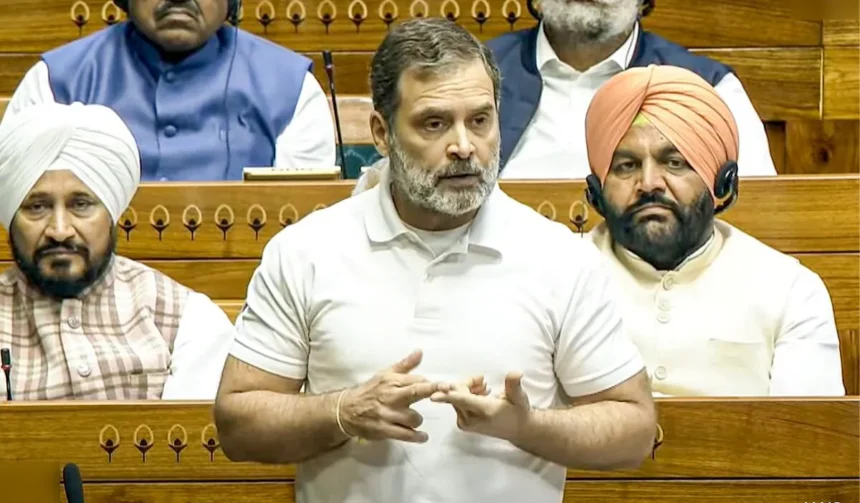
Leader of the Opposition in Lok Sabha, Rahul Gandhi, on Friday raised the pressing issue of air pollution in northern India and other parts of the country, urging a parliamentary discussion to develop a systematic plan to tackle the crisis. Union Minister of Parliamentary Affairs Kiren Rijiju assured Gandhi that the government is open to dialogue and suggestions.
Gandhi highlighted the grave health impacts of deteriorating air quality, stating that millions of children are suffering from lung diseases, with their future at risk. “Most of our major cities are living under a blanket of poisonous air. People are getting cancer. Older people are struggling to breathe,” he said, emphasizing that air pollution is a non-ideological issue that requires cooperation between the government and the opposition.

The Congress MP called for a detailed discussion in Parliament, suggesting that the Prime Minister implement city-wise plans to address pollution over the next five to ten years. Gandhi urged that the debate should focus on solutions rather than blame games, involving experts and showcasing bipartisan cooperation.
Supporting the call, Congress MPs Priyanka Gandhi Vadra and Deepender Hooda stressed the urgency of a national-level action plan. Hooda pointed out inadequate allocation and utilization of funds to combat air pollution, noting that only 1% of the allocated budget for industrial pollution has been spent. Shiv Sena (UBT) MP Priyanka Chaturvedi also welcomed the initiative, emphasizing that both the ruling side and opposition suffer from the effects of polluted air and that political differences should not hinder finding solutions.
In response, Union Minister Rijiju reiterated that the government is ready to discuss the issue in Parliament and take suggestions from all members, including the opposition, to develop effective solutions.
The call for discussion comes amid worsening air quality across multiple cities, particularly in Delhi-NCR, where the AQI was recorded at 349 in the ‘Very Poor’ category. The Commission for Air Quality Management (CAQM) has also constituted an Expert Committee, chaired by IIT Madras Professor Ashok Jhunjhunwala, to address vehicular emission pollution.
Congress MPs and experts hope that a comprehensive parliamentary debate will lead to actionable strategies to reduce air pollution and safeguard public health across the country. (Agencies)