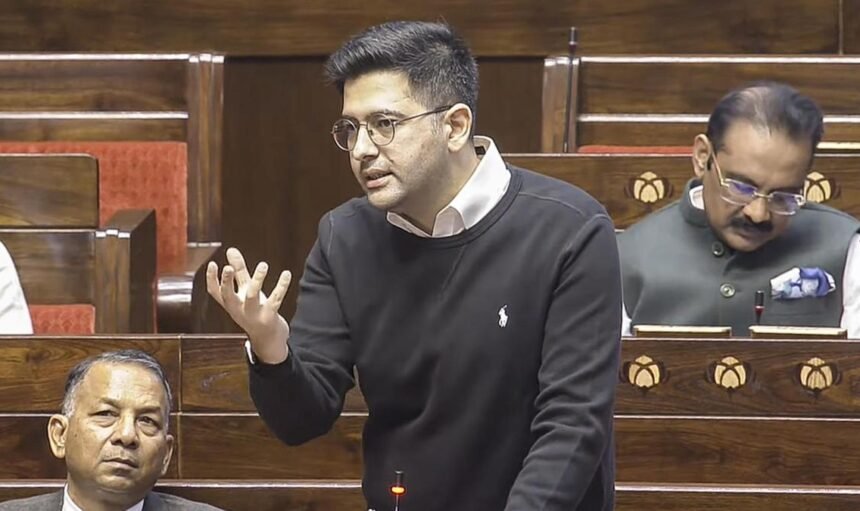
Aam Aadmi Party (AAP) leader Raghav Chadha on Thursday sought key amendments to the Copyright Act, 1957 to safeguard the interests of digital content creators, asserting that their livelihoods should be protected by law and not governed by “arbitrary algorithms”.
Raising the issue during Zero Hour in the Rajya Sabha, the AAP MP from Punjab said millions of Indians today work as digital content creators, serving as educators, reviewers, satirists, entertainers, musicians and influencers.

“Whether it is their YouTube channel or Instagram page, it is not merely a source of entertainment. In fact, it is their source of income, their asset. It is the fruit of their hard work,” Chadha said.
He flagged concerns over fair use and arbitrary copyright strikes by digital platforms, stating that creators often risk losing their entire channels even when copyrighted content is used for just a few seconds for purposes such as commentary, criticism, parody, education or news reporting.
“Years of hard work can end in a few minutes. Livelihoods must be decided by law and not by arbitrary algorithms,” the AAP leader said.
Clarifying that he was not opposing the rights of copyright holders, Chadha stressed that fair use should not be equated with piracy.
“Fair use, where the purpose of using content is incidental or transformative, must not result in wiping out somebody’s hard work. Innovation cannot grow in fear and creativity cannot survive under threat,” he said.
The AAP MP pointed out that India’s Copyright Act was enacted in 1957, long before the advent of the internet, computers, digital platforms, YouTube or Instagram.
“The Act does not even define digital creators. It speaks of fair dealing, but only in the context of books, magazines and journals,” he noted.
Chadha placed three key demands before the House. First, he called for an amendment to the Copyright Act to clearly define digital fair use, including transformative use such as commentary, satire and critique, incidental and proportionate use, educational use, public-interest use and non-commercial use.
Second, he sought the introduction of the doctrine of proportionality in copyright enforcement, arguing that brief background use of audio or video content should not result in complete takedown of a creator’s work.
Third, he demanded mandatory due process before any content is removed from digital platforms. (Agencies)