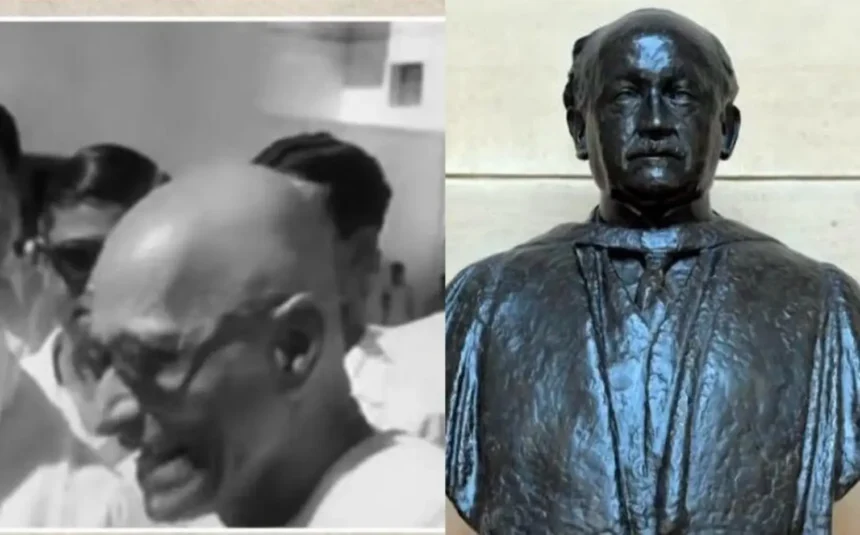
A bronze bust that stood for decades in the central courtyard of Rashtrapati Bhavan will soon be removed. On February 22, Prime Minister Narendra Modi announced that the statue of British architect Edwin Lutyens would be replaced with one of C. Rajagopalachari, also known as Rajaji.
The announcement was made during the 131st episode of Modi’s monthly radio programme Mann Ki Baat. Explaining the move, the Prime Minister said the country was moving away from symbols of colonial rule and giving greater importance to figures rooted in Indian history and culture.
A new statue of Rajagopalachari was unveiled as part of a ‘Rajaji Utsav’, along with an exhibition scheduled to run until March 1. Notably, Lutyens himself had designed Rashtrapati Bhavan—then known as Viceroy’s House—the very building from which his bust is now being removed.
The architect of imperial New Delhi
Born on March 29, 1869, in London, Edwin Lutyens came from an artistic family and later rose to prominence as one of Britain’s leading architects. He initially built a reputation designing English country houses, often collaborating with garden designer Gertrude Jekyll.
His career took a decisive turn after the 1911 Delhi Durbar, when King George V announced that the capital of British India would shift from Calcutta to Delhi. Lutyens was appointed chief architect for the new imperial capital. Working alongside Sir Herbert Baker, he designed several iconic structures, including Viceroy’s House (now Rashtrapati Bhavan), India Gate, North and South Block, Connaught Place, and the grand ceremonial avenue once called Kingsway.
He blended Western classical styles with elements inspired by Mughal and Indian architecture. Knighted in 1918, Lutyens died in 1944. His architectural legacy continues to shape much of central Delhi.
From geography to political label
Over time, “Lutyens’ Delhi” came to describe the 26-square-kilometre zone of bungalows and wide avenues built during the 1920s and 1930s. But the term later evolved into a political metaphor, often used to describe an English-speaking, elite establishment seen as disconnected from ordinary Indians.
Since coming to power, Modi and the BJP have frequently used the term as shorthand for entrenched elitism. Although the Prime Minister resides within this zone, his government has initiated several changes aimed at reshaping its symbolism.
Reworking colonial-era symbols
In September 2022, the government renamed Rajpath—originally designed by Lutyens as an imperial boulevard—to Kartavya Path. In 2023, Modi inaugurated a new Parliament building near the one designed by Baker. More recently, the Prime Minister’s Office shifted from South Block to a newly built complex under the Central Vista Redevelopment Project.
These moves align with Modi’s broader call to shed what he describes as the “mentality of slavery,” one of the pledges outlined in his 2022 Independence Day address.
Rajagopalachari, whose statue will now replace Lutyens’, was a freedom fighter, close associate of Mahatma Gandhi, and the only Indian to serve as Governor-General from 1948 to 1950. Modi has described him as a leader who viewed power as service rather than status.
Even as the bust is removed, Lutyens’ architectural imprint remains deeply embedded in Delhi’s landscape—most visibly in landmarks like India Gate and the grand layout of the capital he helped design. (Agency)