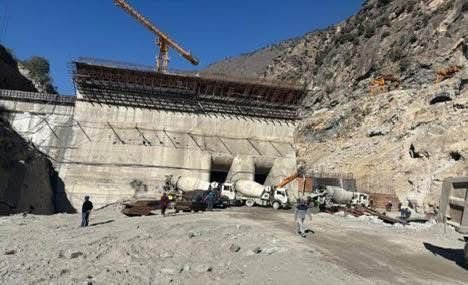
The successful completion of 2,00,000 Cubic Metres (Cum) of dam concreting at the 540 MW Kwar Hydro Electric Project is a critical construction milestone that strongly reinforces India’s commitment to utilizing its rights under the Indus Water Treaty (IWT).

Asif Iqbal Naik
Jammu November 7, 2025: In a significant development underlining India’s accelerated pace in utilizing its share of waters under the Indus Water Treaty (IWT), the Kwar Hydro Electric Project (540 MW) in Kishtwar, J&K, has achieved a major construction milestone. The project successfully completed 2,00,000 Cubic Metres (Cum) of Dam Concreting, out of a total target of 7,50,000 Cum, on the occasion of the 51st Foundation Day of NHPC.
The achievement on the Chenab River—a Western River under the IWT—is being viewed as a powerful symbol of India’s strategic push to harness the region’s vast hydro-power potential, a move that gains added significance amidst the backdrop of recent geopolitical developments concerning the six-decade-old water-sharing pact with Pakistan.
This crucial push for hydro-power projects like Kwar must also be viewed in the immediate geopolitical context following the Pahalgam terror attack of April 2025, which tragically claimed 26 civilian lives, and India’s swift retaliatory military campaign, Operation Sindoor. In the aftermath of the cross-border strikes that targeted terrorist infrastructure in Pakistan and Pakistan-occupied Kashmir, the Indian government also announced the suspension of the Indus Waters Treaty (IWT), declaring that the pact would be held in abeyance until Pakistan credibly and irrevocably abjured support for cross-border terrorism. While the military component of Operation Sindoor was followed by a brief conflict and a ceasefire, the subsequent economic and diplomatic measures, particularly linking the continuation of the IWT to the terror issue, represent a fundamental shift in New Delhi’s policy. The accelerated construction of projects like Kwar, which allow India to utilize its allotted share of Western River waters for power generation—a right previously underutilized—reinforces this new strategy of maximum utilization and demonstrates a firm resolve to leverage all available national resources in response to external security challenges.
Strategic Significance in the Indus Water Treaty Context
The Kwar project, along with other accelerated projects like Pakal Dul (1000 MW), Kiru (624 MW), and Ratle (850 MW), is part of a cluster of high-priority run-of-the-river schemes on the Chenab river. These projects are central to India’s commitment to fully exploit the rights granted to it for power generation on the Western Rivers (Indus, Jhelum, and Chenab) as per the IWT.
Optimal Resource Utilisation: The successful and expedited construction progress signifies India’s commitment to optimally utilize the resources of the Chenab basin for power generation, which is crucial for the energy security and economic upliftment of the Union Territory of Jammu & Kashmir and the country.
A “Big Push” for J&K: The development drive is often framed as a “big push” to triple the region’s current energy generation capacity, making J&K a major hydro-power hub. The Kwar project alone is expected to generate 1975.54 Million Units in a 90% dependable year, contributing significantly to the national grid and regional stability.
Timely Completion: Despite “significant climatic and geopolitical disturbances,” the joint venture, Chenab Valley Power Projects Private Ltd (CVPPL), has maintained the ambitious target of commissioning the project within the scheduled timeline of March 2028. This resilience in execution underscores the strategic importance attached to the project.
Project Details and Leadership Commendation
The Kwar H.E. Project is a joint venture between NHPC Ltd. and JKSPDC Ltd. and is crucial for the development of the Kishtwar district. The team overcame numerous operational hurdles to achieve the 2 lakh Cum concreting milestone in what is often a limited effective working season of only about six months.
The leadership of NHPC and CVPPL, including Sh. Bhupender Gupta (CMD NHPC), Sh. Sanjay Kumar Singh (Director – Projects) NHPC, Sh. Ramesh Mukhiya (Managing Director CVPPL), and others, congratulated the entire team for the feat, highlighting the meticulous planning and round-the-clock supervision that enabled the progress.
“This achievement is not just a construction milestone; it is a clear demonstration of our resolve to transform the Chenab Valley into a hydroelectric powerhouse, which is a vital component of India’s long-term energy strategy,” remarked a senior project official.
The successful completion of the 2,00,000 Cum Dam Concreting effectively paves the way for the timely completion of the entire 540 MW project, reinforcing India’s assertion of its water utilization rights under the IWT.