Pakistan’s Military Tightens Grip as Dissent and Free Speech Come Under Pressure
Pakistan’s jailed former Prime Minister Imran Khan has not seen any visitors in over five weeks, his party says, raising concerns about efforts to limit his communication with the outside world. His family attributes the restrictions to Pakistan’s military chief, Field Marshal Asim Munir—a charge rejected by the government, which says visits were halted because Khan violated jail rules by discussing politics.

Khan is not the only voice facing pressure. Journalists, human rights advocates, and analysts say the space to disagree with the state is shrinking, and the risks of speaking out are rising.
Last weekend, human rights lawyer Imaan Mazari and her husband were sentenced to 10 years in prison for sharing anti-state posts on social media. Amnesty International had urged Pakistan to stop “coercive tactics used to silence dissent and intimidate those who defend human rights.”
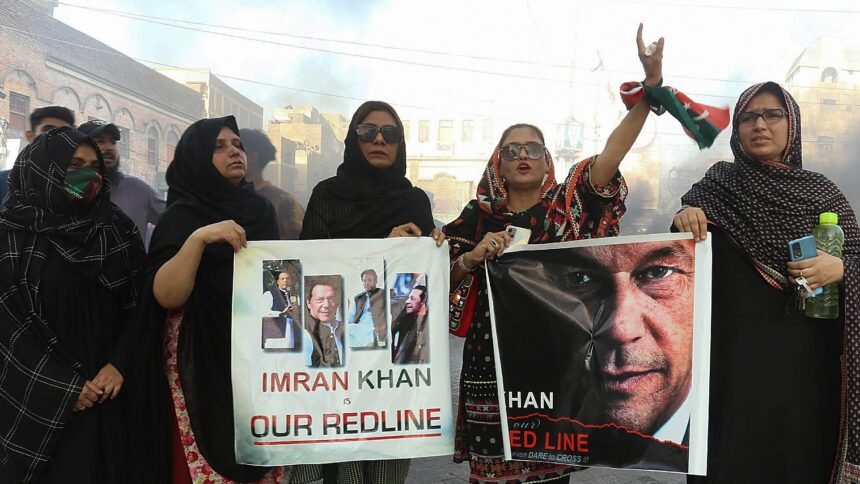
Khan’s family insist there is a deliberate attempt to erase his public presence. “There are two names you can’t have on television. You can’t say anything nice about Imran Khan, and you can’t say anything bad about Asim Munir,” his sister Aleema Khanum told the BBC at a protest near Adiala jail in Rawalpindi.
It has been over eight weeks since Khan saw a family member and more than five since he met a lawyer—then only for eight minutes. Khanum said the restrictions block his fundamental rights to legal counsel, family visits, and communication with supporters, often carried out via his social media accounts.
Khan, imprisoned since August 2023 on several corruption cases he calls politically motivated, has been a frequent critic of the government and the military chief. Following posts on his X account criticizing Munir, Pakistan’s military spokesperson held a nationwide press conference labeling Khan a national security threat.
Observers see the crackdown as part of a broader pattern of increasing military influence over Pakistan’s politics. Michael Kugelman, senior fellow on South Asia at the Atlantic Council, said, “One could argue that the military is really leading the country on so many levels now that Pakistan’s coming quite close to authoritarian rule.”
The military has long been a dominant force in Pakistan’s politics. Khan himself initially enjoyed the military’s backing, which helped him rise to power, but fell out with the establishment by the time he was ousted in 2022. In November 2025, a constitutional amendment granted Munir lifetime immunity and control over Pakistan’s defence forces, further consolidating military influence.
While the government denies that the military dictates policy, human rights advocates argue that the level of control over public discourse, media, and dissent is intrinsically tied to the military’s dominance. Munizae Jahangir, journalist and HRCP co-chair, said, “If the military is more dominant, there will be less space for protest, dissent, and free expression.”
Journalists and media outlets also face restrictions. BBC reporting shows that TV channels have been told to avoid showing Khan or criticizing the military. Staff have been harassed or warned against covering stories linked to the establishment, leading to widespread self-censorship. Changes to Pakistan’s Prevention of Electronic Crimes Act in early 2025 have further limited reporting, making it a crime to criticize the security establishment or judiciary online, with heavy fines and disproportionate penalties.
Media organizations such as Dawn have faced financial and administrative pressures, including alleged bans on government advertisements, though officials deny these claims. Journalists say the law and its unspoken rules create a shifting, unpredictable environment for reporting.
Meanwhile, Pakistanis operating online abroad are also targeted. In January, seven journalists and YouTubers—including two former army officers—were tried in absentia and given life sentences for “digital terrorism” related to 2023 protests following Khan’s first arrest. One of those sentenced, Adil Raja, called the charges “digital terrorism” for speaking truth to power.
Experts say these measures reflect a new approach, where legal and institutional tools are being used alongside traditional intimidation to control dissent. “There’s been a growing realization that the state is excessively willing and unapologetically willing to wield a blunt hammer,” said Azeema Cheema, an Islamabad-based researcher.
Where that hammer may strike next remains uncertain, leaving journalists, lawyers, and activists navigating a climate of fear and shrinking freedom of expression in Pakistan.(Agencies)