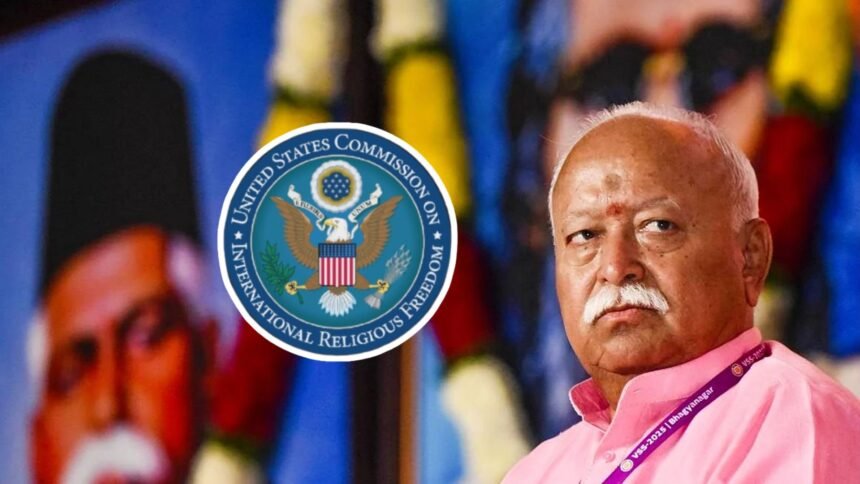
The U.S. Commission on International Religious Freedom (USCIRF), in its 2026 Annual Report released earlier this month, said that religious freedom conditions in India continued to deteriorate during 2025. The report recommends that India be designated a “Country of Particular Concern” (CPC) under the International Religious Freedom Act (IRFA) for what it calls systematic, ongoing and serious violations of religious freedom.
USCIRF is an independent, bipartisan federal body created under the International Religious Freedom Act of 1998 to monitor global religious freedom conditions, review violations, and provide policy recommendations to the U.S. President, the Secretary of State and the United States Congress.

What the USCIRF report says about India
According to the report, during 2025 the Indian government introduced and enforced new measures that it says affected religious minority communities and their places of worship. Several states moved to introduce or strengthen anti-conversion laws with stricter prison penalties. The report also claims that authorities enabled widespread detention and unlawful expulsion of some citizens and religious refugees, while vigilante attacks against minority communities were often not adequately addressed. It further alleges that Hindu nationalist groups carried out harassment and violence against Muslims and Christians in multiple states during the year.
In March, violence broke out in Maharashtra after the Vishwa Hindu Parishad (VHP) called for the removal of the tomb of Aurangzeb, a 17th-century Mughal ruler. The unrest led to riots in which dozens of people were injured. In June, officials of the Bharatiya Janata Party (BJP) in Odisha reported incidents of Qurans being desecrated during around 20 protests led by the VHP. The clashes reportedly left eight people injured, with allegations of limited police intervention.
In April, three gunmen attacked predominantly Hindu tourists in Kashmir, killing 26 people after reportedly asking victims to recite the Kalma and targeting those unable to do so. The attack triggered a brief five-day escalation between India and Pakistan. Following the incident, alleged hate-crime cases were reported in Karnataka and Uttar Pradesh. In Uttarakhand, members of a Hindu nationalist group allegedly shot and killed a Muslim restaurant owner in what they described as retaliation for the Kashmir attack; authorities later sealed the restaurant.
After the attack, authorities defended the deportation of certain religious minorities who were identified as “illegal” migrants. In May, about 40 Rohingya refugees, including 15 Christians, were reportedly detained and transported to international waters off Myanmar (Burma), where they were forced to swim ashore wearing life vests. In July, hundreds of Bengali-speaking Muslims were expelled from Assam to Bangladesh, despite claims that some were Indian citizens. BJP officials described them as “infiltrators” posing a threat to national identity.
In September, new provisions under the Foreigners Act expanded the powers of tribunals to issue arrest warrants and detain suspected “foreigners” without due process. The government also moved to take greater control over Waqf properties. In May, Parliament passed the Waqf Bill, allowing non-Muslims to be included on boards managing endowments such as mosques, seminaries, and graveyards. Protests in West Bengal turned violent, leaving three people dead.
In September, the Supreme Court of India suspended key provisions of the law, limiting the number of non-Muslim members on federal Waqf boards to four. During the same month, Uttarakhand passed the State Authority for Minority Education Act, dissolving the Madrasa Board and placing madrasas as well as institutions run by Sikhs, Buddhists, Jains, Parsis and Christians under state oversight.
USCIRF Policy Recommendations to the U.S. Government
The U.S. Commission on International Religious Freedom (USCIRF) has recommended that the United States designate India as a Country of Particular Concern (CPC) under the International Religious Freedom Act (IRFA), citing what it describes as serious and ongoing violations of religious freedom.
The report also calls for targeted sanctions against individuals and organisations allegedly involved in such violations, including the Rashtriya Swayamsevak Sangh (RSS). These measures could include freezing assets and denying entry into the United States.
Additionally, USCIRF urged the U.S. government to press India to allow in-country assessments by USCIRF and the U.S. Department of State. It further suggested linking future U.S. security assistance and trade engagement with improvements in religious freedom. The report also recommends enforcing provisions of the Arms Export Control Act, including Section 6, which could halt arms sales in cases involving intimidation or harassment of U.S. citizens and religious minorities.