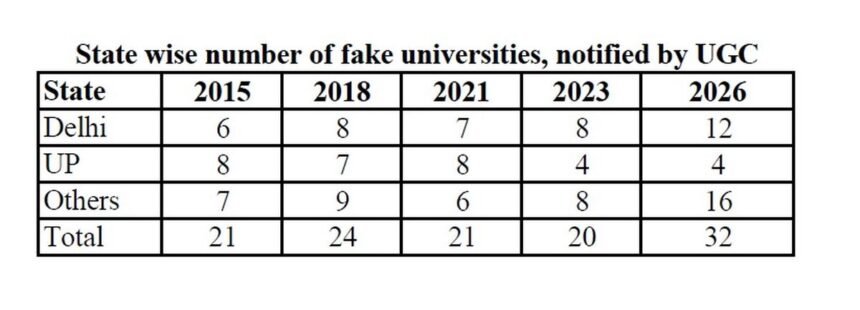
In a major step to protect students, the University Grants Commission (UGC) issued its February 2026 notification identifying 32 fake universities across 12 states. This reflects a sharp 60% rise from 20 such institutions in 2023, underlining the ongoing challenge of maintaining standards and credibility in India’s higher education sector.
What is a fake university?
According to UGC guidelines, a fake university is a Higher Education Institution (HEI) that is not legally recognised under the UGC Act, 1956, yet uses the term “University” to mislead students. Such institutions often promise easy and inexpensive degrees that hold no valid recognition for jobs or higher studies.
Why does the UGC notify fake universities?
The UGC regularly issues public notices through its website, social media platforms and other media channels to alert students and parents about fraudulent institutions. It also serves show-cause notices and warnings to unauthorised bodies that continue to operate and award invalid degrees.
Additionally, the UGC writes to education secretaries of the concerned states, urging action to shut down such institutions, since enforcement and law-and-order responsibilities fall under state governments. The commission also updates its list of fake universities online, enabling students to verify the authenticity of institutions before taking admission.
Rise of “shadow” universities
An analysis of UGC data since 2015 shows that the number of fake universities remained between 20 and 24 until 2023, before rising sharply to 32 in 2026. As of February 2026, Delhi accounts for 12 fake universities (38% of the total), followed by Uttar Pradesh with four, and two each in Andhra Pradesh, Karnataka and West Bengal.
New clusters have emerged in Arunachal Pradesh, Jharkhand and Haryana, suggesting that such entities are increasingly targeting areas with lower awareness and limited digital literacy.
While 12 institutions — including five from Delhi and three from Uttar Pradesh — have been on the list for more than a decade, only 12 fake universities have been officially confirmed as closed, according to a written reply by the Minister of State for Education in the Lok Sabha on December 16, 2024.
In several cases, institutions reportedly shut operations within months of being notified, only to reopen under a different name. The Ministry has reiterated that maintaining law and order, including shutting down fraudulent institutions, remains the responsibility of state governments. (Agency)