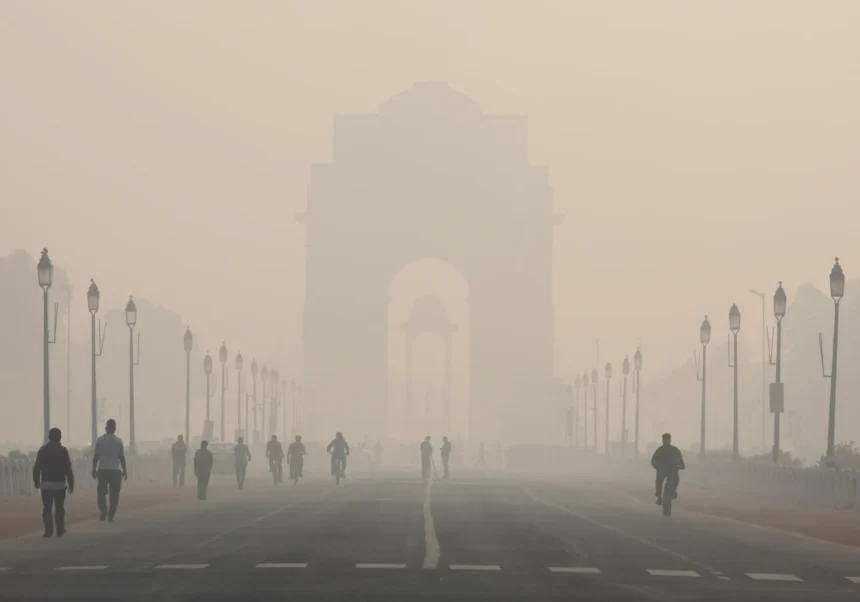
As winter settles in, a thick blanket of smog engulfed the national capital on Wednesday morning, pushing Delhi’s air quality deep into the ‘Very Poor’ category. The city recorded an AQI of 376 at 7 am, according to the Central Pollution Control Board (CPCB).
Prominent landmarks such as India Gate and Kartavya Path were shrouded in dense, toxic haze, with the AQI in the area measured at 356.

Several other major stations also reported dangerous pollution levels — Alipur (366), Aya Nagar (360), Burari (396), Dhaula Kuan (303), and Dwarka (377) — all falling in the “very poor” category.
CPCB data showed that multiple monitoring stations crossed the “severe” threshold, with Anand Vihar recording an AQI of 405, Ashok Vihar 403, Chandni Chowk 431, and Jahangirpuri 406. Nearly all stations across Delhi reported air quality ranging from “very poor” to “severe”, indicating widespread and alarming pollution.
The Air Quality Index (AQI), measured on a scale of 0 to 500, categorises pollution levels and corresponding health risks:
-
0–50: Good — minimal or no health impact
-
51–100: Satisfactory — acceptable, with mild discomfort for sensitive groups
-
101–200: Moderate — can affect those with asthma, lung conditions, or heart disease
-
201–300: Poor — prolonged exposure may cause breathing discomfort to most people
-
301–400: Very Poor — risk of respiratory illness even among healthy individuals
-
401–500: Severe — hazardous for everyone, with serious health implications
This deterioration in air quality has become a recurring winter pattern for the national capital, driven by stagnant winds, rising moisture levels, and seasonal pollution sources.