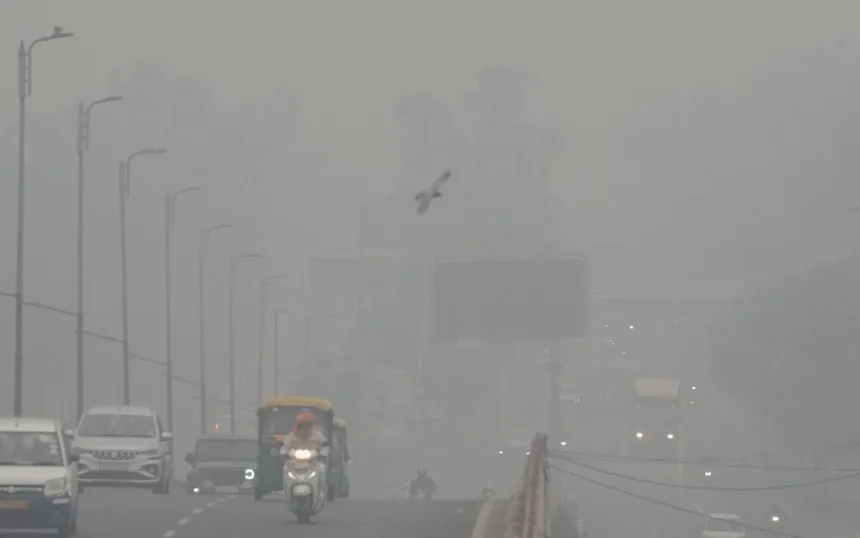
The national capital, Delhi, continued to grapple with poor air quality on Monday, with the overall Air Quality Index (AQI) recorded at 452 at around 8 am, placing it in the ‘severe’ category, according to data from the Central Pollution Control Board (CPCB).
This followed a similar trend on Sunday, when the AQI stood at 461 at around 4 pm.

Large parts of the city were blanketed by a dense layer of toxic smog, significantly reducing visibility and causing discomfort to residents. Areas such as Anand Vihar recorded an AQI of 409, while thick smog was also reported around Kartavya Path, Akshardham, AIIMS and Yashobhoomi.
As per CPCB data, several localities including Aya Nagar (406), Chandni Chowk (437), RK Puram (477) and Dwarka Sector 8 (462) remained in the ‘severe’ category. Wazirpur recorded an AQI of 500.
Under the AQI classification, readings between 401 and 500 fall under the ‘severe’ category.
Earlier, the Commission for Air Quality Management in NCR and Adjoining Areas (CAQM) deployed 19 teams for a road inspection drive on December 12 as part of ongoing monitoring and enforcement under the Graded Response Action Plan (GRAP).
According to CAQM, 136 road stretches under the Delhi Development Authority (DDA) were inspected. Of these, 15 stretches showed high visible dust levels, 38 moderate dust, 61 low dust intensity, and 22 had no visible dust. Accumulation of municipal solid waste and construction and demolition waste was reported at 55 and 53 stretches, respectively, while six stretches showed evidence of MSW or biomass burning.
The Commission noted recurring gaps and negligence in road maintenance and stressed the need for improved operational efficiency and timely dust-mitigation measures. It also emphasised stronger on-ground action, including regular mechanical sweeping, proper disposal of collected dust, maintenance of road shoulders and central verges, deployment of water sprinkling systems, and strict prevention of open burning across all DDA-maintained stretches. (Agencies)