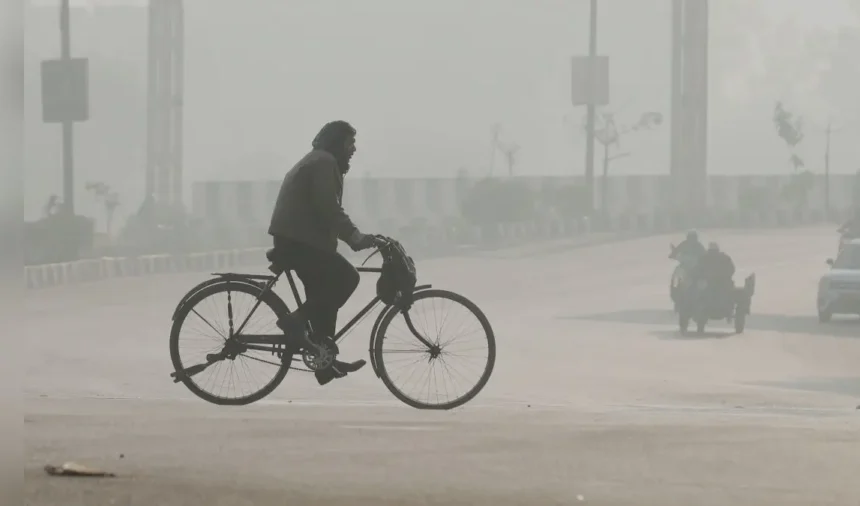
Delhi’s air quality deteriorated sharply on Saturday morning, with the overall Air Quality Index (AQI) recorded at 393 around 8 am, placing it in the ‘Very Poor’ category, according to data released by the Central Pollution Control Board (CPCB).
The decline comes amid a continuation of poor air quality conditions observed on Friday as well. Official data showed the AQI stood at 349 around 4 pm on December 12. Several parts of the national capital remained shrouded in a dense layer of toxic smog, severely affecting visibility and causing widespread discomfort to residents.

Several locations in Delhi slipped into the ‘Severe’ category. As per CPCB data, Anand Vihar recorded an AQI of 436, while Ashok Vihar stood at 435. Other areas including ITO (425), Delhi Technological University (426), and Nehru Nagar (427) also witnessed severe air quality levels.
However, air quality varied across the city, with some areas remaining in the ‘Very Poor’ category. Najafgarh recorded an AQI of 312, while Shadipur registered 375. Okhla Phase 2 and Dwarka Sector 8 recorded AQI levels of 400 and 394 respectively, indicating marginally better conditions compared to severely affected areas, though still unhealthy.
As per AQI classification, values between 0–50 are considered ‘Good’, 51–100 ‘Satisfactory’, 101–200 ‘Moderate’, 201–300 ‘Poor’, 301–400 ‘Very Poor’, and 401–500 ‘Severe’.
Meanwhile, Delhi Chief Minister Rekha Gupta said on Friday that her government is working on multiple fronts to control pollution in the capital in an effective and sustainable manner. She said eliminating dust pollution is among the government’s top priorities, with wall-to-wall roads being constructed across Delhi at an accelerated pace.
According to the Chief Minister’s Office (CMO), CM Gupta stated that MLAs have been provided with substantial funds amounting to several crores to ensure smooth execution of road construction projects. She stressed that pollution control cannot be achieved through government efforts alone and requires active public participation.
Highlighting that flying dust is a major contributor to Delhi’s pollution, the Chief Minister said wall-to-wall roads offer a long-term solution to curb dust along road edges. She instructed MLAs to ensure that all new road construction and repair works strictly follow the wall-to-wall model and assured that additional funds would be provided immediately if required.