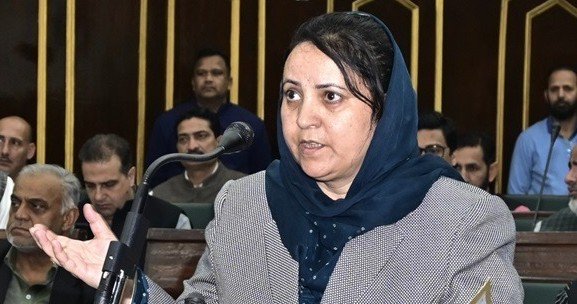
“We are not implementing the TET orders immediately. J&K will be the last in the country to conduct the TET examination,” Itoo told reporters in Kulgam.
Clarifying reports about a purported government directive, the Minister said no fresh order has been issued for the enforcement of TET in the Union Territory.

“We have not issued any fresh order for the immediate implementation of TET,” she said, dismissing claims circulating on social media.
Itoo said the Supreme Court has granted a two-year window to states and Union Territories to comply with its directive on TET, and the J&K government will take a considered decision after examining its implications.
“After receiving the relevant case file, we decided to study the pattern, mechanism and practical implications of the examination in other states and UTs,” she said.
She added that the government would review the matter once the directive is implemented uniformly across the country or if further directions are issued by the apex court.
“If it is implemented across the country and further directions are received from the Hon’ble Supreme Court, we will review the matter accordingly. But as of now, there is no immediate enforcement,” she said.
Earlier, the School Education Department designated the Jammu and Kashmir Board of School Education as the nodal agency to conduct the TET examination in compliance with the Supreme Court directive.
The Minister also said the concept of an eligibility test for teachers was not new to J&K, recalling a similar move during the previous PDP-led government.
“It had been envisioned during the tenure of late Chief Minister Mufti Mohammad Sayeed, and former Education Minister Naeem Akhtar had initiated steps to examine Rehbar-e-Taleem (RET) teachers,” she said, adding that the current directive is an extension of that initiative.
However, Itoo stressed that any decision to enforce TET must take into account the long service record of teachers in the Union Territory.
“Many teachers have rendered 25 to 35 years of service and have educated generations of students who are now doctors, engineers, IAS, KAS officers, teachers and professors,” she said.
“Any decision impacting them must be taken after careful consideration of the consequences and ground realities.” ( Agencies)