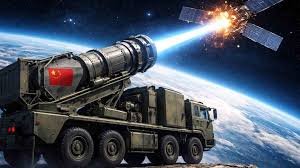
New Delhi: China has developed a high-power microwave system that could potentially be used to disrupt satellite networks such as SpaceX’s Starlink, according to media reports.
Chinese experts claim that a ground-based microwave weapon with an output exceeding one gigawatt could be powerful enough to seriously interfere with or even damage Starlink satellites operating in low Earth orbit. The development was reported by the South China Morning Post (SCMP).

High-power microwave weapons have gained attention in recent years as militaries seek cost-effective and sustainable alternatives to conventional missiles and firearms.
Researchers led by Wang Gang at the Northwest Institute of Nuclear Technology in Xi’an, Shaanxi province, have developed a system called TPG1000Cs, capable of generating extremely powerful microwave pulses for much longer durations than earlier technologies. The system can reportedly deliver up to 20 gigawatts of power continuously for nearly one minute.
The device measures about four metres in length and weighs roughly five tonnes. Earlier high-power microwave systems were significantly larger and could operate only for a few seconds before overheating or exhausting stored energy.
Chinese officials and military researchers have repeatedly expressed concerns that Starlink poses national security risks, prompting efforts to develop counter-measures, often referred to as a potential “Starlink killer.”
According to findings published in the journal Chinese High Power Laser and Particle Beams, the system is designed for deployment on trucks, ships, aircraft, or potentially in space.
Researchers said the new system can operate on a scale not previously achieved by high-power microwave devices, delivering up to 3,000 high-energy microwave pulses in a single operational session. During trials, the system reportedly completed more than 200,000 test pulses with stable performance.
The TPG1000Cs also marks a major upgrade over earlier Hurricane-series high-power microwave weapons, which were mainly intended for short-range air defence. Mounted on vehicles, earlier systems could disable drones within a range of two to three kilometres. The new device, however, has been developed to engage more distant targets due to its extended operating capability. (Agencies)